



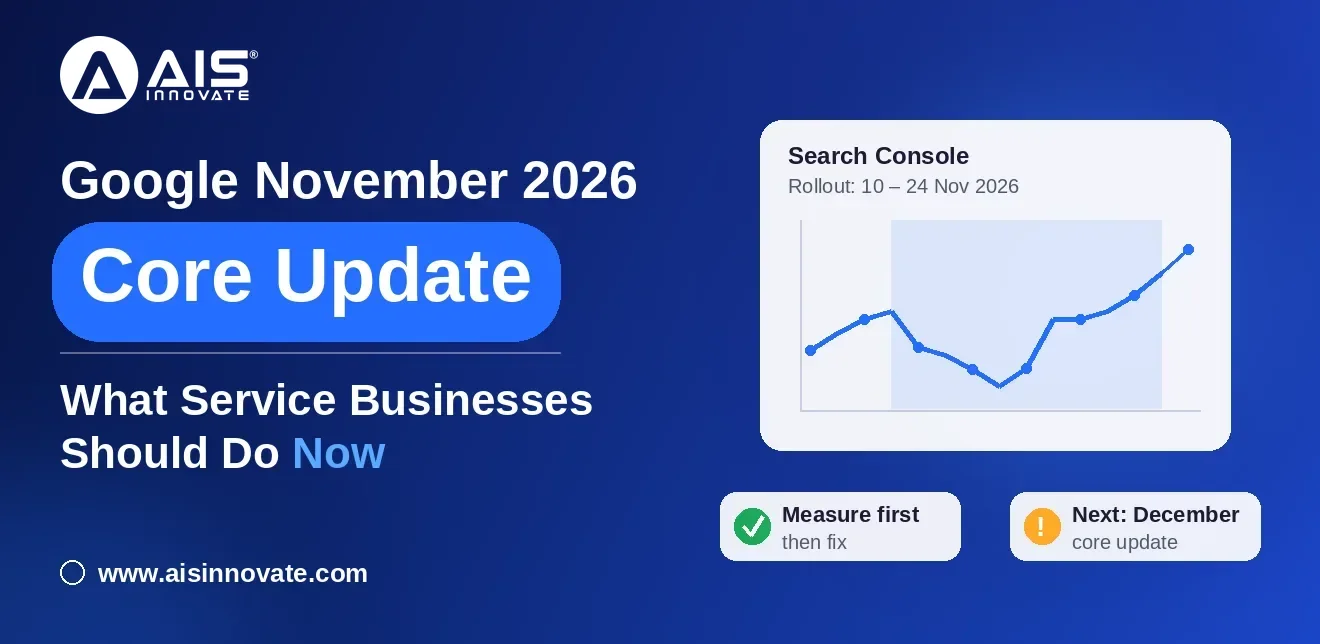
The Google November 2026 core update rolled out from 10 to 24 November 2026. Service businesses should not rush into changes: wait a week, compare 25 November–1 December with 3–9 November, and look at service pages and blog content separately. Google has also pre-announced a December core update, so measure November quickly.
Google's November 2026 core update has finished rolling out, and the question most business owners are asking is whether they should act now. The short answer: measure first, change very little until the data is clean, and get ready for a second update in December. This guide explains what happened, how to read your Search Console data, what we saw on our own site and what service businesses should do next.
Key Takeaways:
- The update is over. It began on 10 November 2026 and Google confirmed it complete on 24 November. It is the third core update this year, after March and May.
- Another one is coming. On 24 November Google pre-announced a December 2026 core update.
- Don't rush into changes. Wait a full week after completion, then compare 25 November–1 December with a pre-update week.
- Use a clean baseline. Start your comparison on 3 November to avoid a bot-driven click spike from 31 October to 2 November.
- Segment by page type. Compare service pages, blog content and any templated pages separately.
- Leave winners alone. Don't edit pages that are already performing well.
- Track AI visibility too. Some specialists report AI citations moving in step with rankings.
In This Article
- 01What is the Google November 2026 core update?
- 02A second core update is coming in December
- 03What have SEO specialists noticed so far?
- 04What we saw on our own site
- 05What should service businesses do now?
- 06How to read your Search Console data
- 07Which pages are most at risk?
- 08How to prepare for the December update
- 09What not to do after a core update
- 10How can AIS Innovate help?
What is the Google November 2026 core update?
A core update is a broad change to Google's ranking systems, not a penalty aimed at one type of site. Google called November's update "a regular update designed to better surface relevant, satisfying content for searchers from all types of sites", and it applied globally and to all languages.
The rollout began on 10 November 2026, and the Google Search Status Dashboard recorded it as complete on 24 November, inside the two-week window Google gave at launch. It follows the March and May 2026 core updates; our May 2026 core update analysis covers that one. Google also says core updates "don't target specific sites or individual web pages". A page that moves down isn't necessarily a bad page; others may simply be judged more helpful for that search.
| 2026 core update | Rollout |
|---|---|
| March 2026 core update | 27 March – 8 April |
| May 2026 core update | 21 May – 2 June |
| November 2026 core update | 10 – 24 November |
| December 2026 core update | Pre-announced 24 November; scheduled for December |
A second core update is coming in December
Google pre-announced the December 2026 core update on 24 November, about an hour after confirming November's rollout was complete. That gives service businesses a short window to measure November before the results shift again.
In Google's words, the December update "focuses on multiple improvements to how our systems understand and rank relevant content (including for longer and more complex questions), as well as improving personalized results for people who have personalization turned on." Google has not given a start date. Run your November comparison as soon as the 1 December data is in Search Console, so the two updates don't blur together.
What have SEO specialists noticed so far?
Patterns are emerging, but they are observations, not confirmed causes. Google has not said any specific type of site was targeted.
Glenn Gabe, SEO and AI search consultant at G-Squared Interactive, dated the visible impact to 13 November, with Search Console showing surges and drops from that day. He also noted that third-party SEO tools were unreliable early in the rollout, so Search Console is the better source.
Lily Ray, VP of SEO and AI Search at Amsive, shared examples of six sites where folders built from one repeated template, such as a page per word or per area code, were falling fast. On those sites, the blog and resources sections dropped while the main product and brand pages stayed strong. She also saw AI Overview and AI Mode citations to those folders fall in a similar way.
What we saw on our own site
On aisinnovate.com, our blog lost more than half its search impressions during the rollout, while our service and main pages more than doubled theirs. That is the same split Lily Ray described.
| Google Search Console | 3–9 Nov (before) | 17–23 Nov (during) |
|---|---|---|
| Blog posts: impressions | 9,861 | 4,189 (−58%) |
| Blog posts: clicks | 8 | 7 |
| Service and main pages: impressions | 454 | 972 (+114%) |
| Service and main pages: clicks | 12 | 19 (+58%) |
Our biggest single loss was our brochure design guide, a broad how-to article on a search where Google can choose from many design tools and template sites. Two caveats: these weeks fall during the rollout, not after it, and we improved several service pages on 19–20 November, so part of their rise is our own work. We will update this post with the full post-rollout comparison in early December.
What should service businesses do now?
Follow these steps in order. Most of the work is measurement, not editing.
- Don't change pages that are performing well. Google's own guidance is to avoid changing content that already performs well. If leads and rankings are stable or up, protect those pages; constant edits make it harder to see what is working.
- Wait for the right comparison window. Google recommends waiting at least one full week after a rollout completes. For this update, that week is 25 November to 1 December, and the 1 December data appears in Search Console only after that day ends.
- Set a clean baseline. Compare that week with 3 to 9 November. Starting on 3 November matters because some site owners saw a click spike from 31 October to 2 November that Marie Haynes reported was bot traffic. A Google logging issue also lowered impressions in the Generative AI performance report from 9 to 11 November.
- Allow for holiday traffic. The comparison week includes Thanksgiving, Black Friday and Cyber Monday. Where holiday demand affects you, also compare the same dates last year.
- Segment your data by page type. Use a page filter in the Performance report to compare service pages, blog content and any templated folders separately. Review Web, Image, Video and News results individually too. A site-wide average can hide one section falling while another grows.
- Check your AI visibility. Open the Generative AI performance report in Search Console and test your key questions in ChatGPT, Perplexity and Google AI Overviews. Record which of your pages are cited before and after.
- Diagnose before you fix. If a section dropped, review it against Google's core update guidance and self-assessment questions. Does each page offer original information, does a real expert stand behind it, and does it fully answer the search? Fix the weakest pages first, and avoid site-wide rewrites.
How to read your Search Console data
| Comparison | Dates | Why it matters |
|---|---|---|
| Pre-update baseline | 3–9 November 2026 | Avoids the 31 October–2 November bot spike |
| Post-update week | 25 November–1 December 2026 | First full week after the 24 November completion |
| Year-on-year check | Same dates in 2025 | Separates holiday seasonality from update impact |
| Treat with caution | 9–11 November 2026 | Logging issue in the Generative AI report |
| Don't mix in | From the start of the December update | A new rollout will blur the November results |
Which pages are most at risk?
Based on what specialists are reporting, the highest-risk pages for service businesses are:
- Near-identical location pages: a page for every city or suburb that only swaps the place name adds little unique value.
- Thin or off-topic blog content: posts that target searches unrelated to what you sell can weaken the whole section.
- Repeated templates at scale: hundreds or thousands of pages built from one pattern are the clearest pattern in the examples shared so far.
Main service and brand pages are usually more resilient, so protect and strengthen them rather than rewrite them.
How to prepare for the December update
Google says December's update is about longer, more complex questions and personalised results. Pages that answer detailed buyer questions clearly will be best placed. Google has shared no more detail, so these steps are our reading:
- Answer the whole question. Buyers increasingly search in full sentences that combine cost, scope, timeline and location. Service pages should answer all four.
- Lead with the answer. Open each section and FAQ with a one- or two-sentence answer, then explain. This is also the structure AI answers quote; see our guide to GEO vs SEO.
- Keep business facts consistent across your website, Google Business Profile and directory listings.
- Make your site easy for machines to read, with clear headings, accurate structured data and, if it suits your site, an llms.txt file.
What not to do after a core update
- Don't make large changes in the first few days. Rankings can shift again as Google adjusts other systems.
- Don't blame one factor without evidence. Google has not said it targeted AI-written content or any single issue.
- Don't delete pages in a panic. Merge, improve or redirect them only once you know they underperform.
- Don't buy links to "recover". Paid links not marked as sponsored break Google's spam policies.
- Don't rely on third-party dashboards alone. Cross-check them against Search Console.
How can AIS Innovate help?
AIS Innovate helps service businesses read their search data calmly and act on what matters. With more than 20 years as a branding and digital marketing agency and offices in India, the USA, Canada and the UK, our team combines technical checks, content reviews and AI search visibility tracking. We measure every page change at around 15 and 25 days, and if a change makes things worse, we propose restoring the previous version. That discipline helped Spar & Bernstein achieve 14x organic traffic growth. Find out more about our SEO services.
Sources: Google Search Status Dashboard; Google Search Central, "Google Search's core updates and your website" and its November 2026 LinkedIn announcement; Search Engine Journal (10 and 25 November 2026); AIS Innovate Google Search Console data, 3–23 November 2026.
LET'S DISCUSS YOUR IDEAS
We'll review your Search Console data and give you a clear, prioritised plan before December's update.
Talk to Our SEO Team
 2 June 2026