Key Takeaways:
- GEO (Generative Engine Optimization) is the discipline of making your content visible inside AI-generated answers, not just search engine result pages.
- Traditional SEO and GEO serve different algorithms — you need both, but the tactics are distinct.
- AI engines like ChatGPT and Gemini use a process called Retrieval-Augmented Generation (RAG) to select sources — structured, authoritative content wins.
- Information density, Q&A formatting, schema markup, and a strong off-site digital footprint are the four pillars of GEO.
- E-E-A-T signals (Experience, Expertise, Authoritativeness, Trustworthiness) are even more critical for AI citation than for Google rankings.
Generative Engine Optimization (GEO)
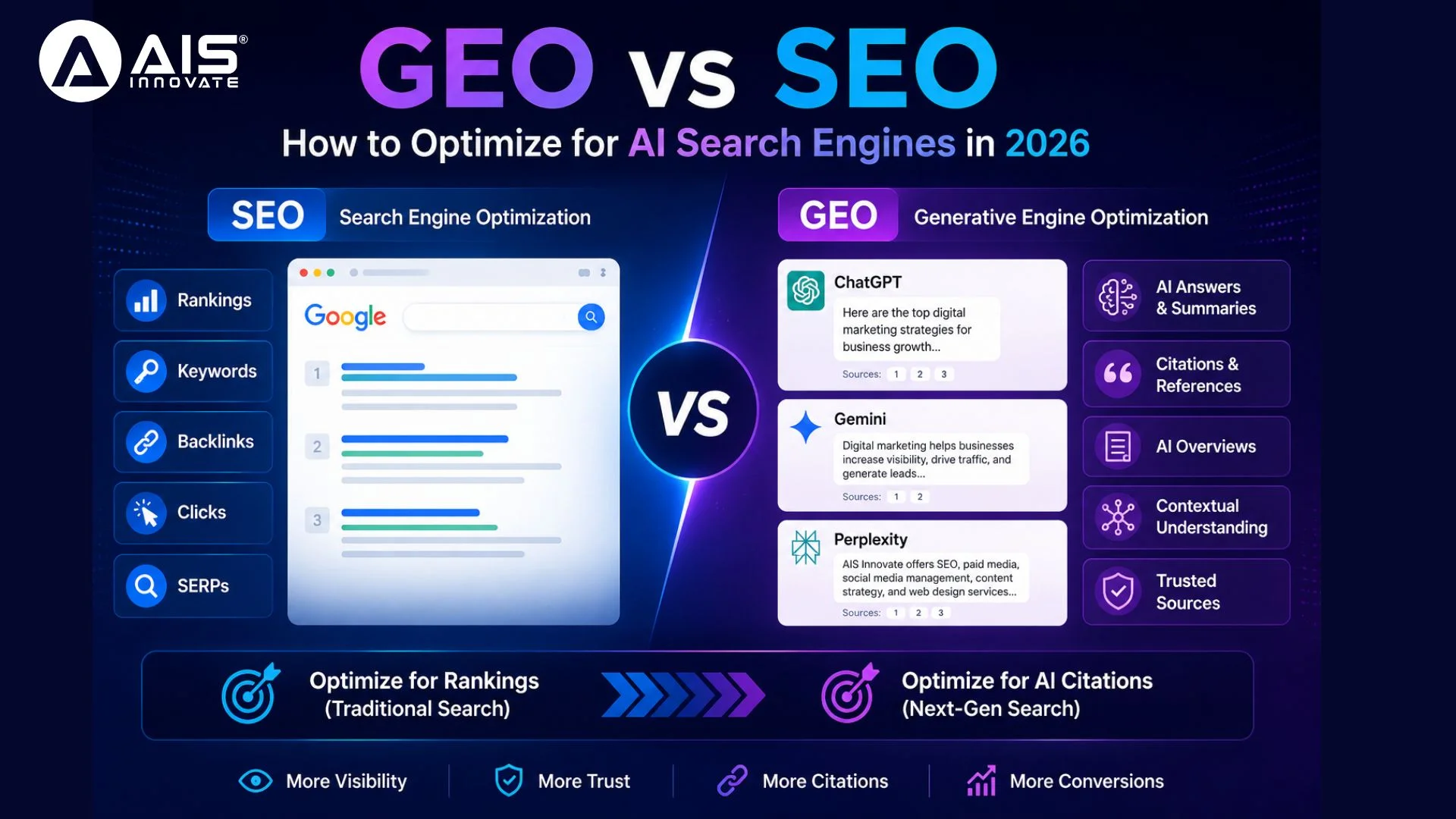
Generative Engine Optimization (GEO) is the practice of structuring and enriching your website content so that AI-powered search engines — including ChatGPT, Gemini, and Perplexity — actively cite and recommend your brand in their responses.
Unlike traditional SEO, which focuses on keyword rankings and backlinks, GEO prioritizes information density, contextual authority, and structured data — so LLMs choose your content as a trusted source.
Here's a scenario that's playing out in millions of offices right now: A marketing manager needs a B2B AI marketing strategy. Instead of typing a query into Google and clicking through five tabs, they open ChatGPT and ask, "
What is the best digital marketing agency for SaaS companies?" They get a direct answer — with three brand recommendations — and they never visit a search results page at all.
This is not a future scenario. It is happening today.
A 2024 study by SparkToro found that zero-click searches on Google had already surpassed 58%. With the rise of AI-native search, that number is only climbing. Users are no longer just skipping the ads — they are skipping the links entirely. If your business is not visible inside AI-generated answers, you are losing leads to competitors who are.
This article breaks down exactly what Generative Engine Optimization is, how it fundamentally differs from traditional SEO, and the five tactical steps your business can take right now to start appearing in AI search results on ChatGPT, Gemini, and Perplexity.
Before diving into tactics, it helps to understand what you are actually optimizing for. Traditional SEO and GEO are not competing strategies — they are complementary layers of a modern digital marketing approach. But they optimize for fundamentally different systems.
Search engine optimization services is built around getting a crawler — Googlebot — to index, understand, and rank your pages. GEO is built around getting a language model to treat your content as a credible, citable source when it constructs an answer.
| Feature | Traditional SEO | Generative Engine Optimization (GEO) |
|---|
| Primary Target | Search engine crawlers (Googlebot) | Large Language Models (LLMs) |
| User Goal | Click through to a website link | Direct, comprehensive answers in-chat |
| Key Metric | Keyword rankings & click-through rate (CTR) | Brand citations & share of voice in AI prompts |
| Content Focus | Keyword optimization & backlinks | Information density, statistics & trust signals |
| Success Signal | Page 1 ranking on Google | Your brand cited in ChatGPT / Gemini answers |
| Optimization Layer | On-page, off-page & technical SEO | Structured data, authority signals & Q&A format |
| Result Timeline | 3–6+ months for new pages | 4–12 weeks for AI citation improvement |
The key strategic insight is this: SEO gets you found. GEO gets you recommended. In an AI-first search environment, being recommended carries far more commercial weight.
To optimize for AI engines, you first need to understand how they actually pull and synthesize information. The core mechanism is called Retrieval-Augmented Generation (RAG) — and once you understand it, the GEO tactics below will make intuitive sense.
Here is how RAG works in plain business terms:
Google AI Mode & AI Overviews
Google's AI Overview and AI Mode pull content from the same index that powers organic rankings — but with one critical distinction: E-E-A-T (Experience, Expertise, Authoritativeness, Trustworthiness) is weighted far more heavily than in traditional search. Google is not just asking "is this page relevant?" It is asking "is this a trustworthy human expert writing from real experience?"
To earn citations in Google AI Mode:
- Add a named, credentialled author to every article — include a bio with verifiable credentials, not just "AIS Innovate Team"
- Implement Article schema with
author, datePublished, and dateModified fields - Write in short, quotable paragraphs — AI Overviews extract 1–2 sentence passages, so dense blocks are skipped
- Deploy FAQ schema on every blog post targeting informational queries
- Maintain a strong traditional SEO foundation — AI Overviews pull almost exclusively from pages already ranking in the top 10 for a given query
ChatGPT (Browse Mode)
A common misconception: ChatGPT searches Google. It does not. When Browse Mode is active, ChatGPT uses the Bing index — Microsoft's search infrastructure — to retrieve live web content. This means pages that are well-indexed in Google but ignored by Bing are invisible to ChatGPT's real-time retrieval.
To get cited by ChatGPT Browse Mode:
- Submit your sitemap to Bing Webmaster Tools and verify your site — this is step one that most businesses skip entirely
- Check your Bing indexing via
site:yourdomain.com in Bing search; if pages are missing, fetch them through Bing Webmaster Tools - Format content as direct-answer blocks — ChatGPT favours pages that open with a clear, complete answer to a question before expanding with context
- Build Bing-specific authority: ensure your brand appears in Microsoft-ecosystem properties (LinkedIn, Microsoft News, Bing Places for Business)
- Keep your robots.txt permissive for Bingbot — accidentally blocking it cuts you out of ChatGPT's retrieval pool entirely
Perplexity
Perplexity is the most citation-forward of the major AI engines — it displays inline source references for virtually every claim it makes, which means your brand name and URL can appear prominently inside answers even when you are not the primary source. This makes Perplexity the highest-visibility opportunity for brand mentions relative to content investment.
To maximise Perplexity citations:
- Publish original statistics and proprietary data — Perplexity disproportionately cites sources that contain numbers that cannot be found elsewhere
- Use clear attribution language: phrases like "According to [your company]'s 2025 analysis..." signal that your data is original and citable
- Appear in third-party directories and industry roundups — Perplexity frequently synthesises from aggregator pages (Clutch, G2, Forbes Advisor), so being listed there extends your citation surface area
- Structure content with clear, descriptive subheadings — Perplexity's retrieval favours documents where each section answers a distinct sub-question
Gemini
Gemini is Google's AI model, and its retrieval signals are the most tightly integrated with the broader Google ecosystem. Beyond E-E-A-T and structured data, Gemini actively draws on the Knowledge Graph — Google's entity database — to verify brand and individual identity. If your business does not exist as a recognised entity in Google's Knowledge Graph, Gemini is less likely to cite it confidently.
To earn citations in Gemini:
- Claim and fully optimise your Google Business Profile — this is the fastest path to establishing entity recognition in the Knowledge Graph
- Build a Google Knowledge Panel for your brand or key personnel by ensuring consistent NAP (Name, Address, Phone) data across all Google-connected platforms
- Publish and maintain profiles on Google-ecosystem properties: YouTube, Google Podcasts, Google Scholar (if applicable), and Google News-approved publications
- Write in structured, factual English — Gemini responds to the same clarity signals as Google Search: declarative sentences, specific claims, authoritative sourcing
- Apply full E-E-A-T across all content, with particular attention to the "Experience" element — first-person case studies, client outcomes with specific metrics, and dated author credentials carry the most weight
Step 1: The Prompt
A user asks a specific, intent-driven question — for example, "Which digital marketing agency in India specializes in SaaS growth?" The AI model does not just reach into its training data. It treats this as a live retrieval task.
Step 2: The Retrieval
The model sends a set of sub-queries to a curated index of web pages. This index is not the entirety of the internet — it skews toward high-authority domains, pages with clear structured data, frequently cited sources, and content that has been indexed by platforms the AI trusts (think Google Search, Bing, major publication databases, and vetted third-party sites).
This is why your off-site digital footprint matters. If your agency is discussed on LinkedIn, Clutch, G2, and Quora — and those sources are authoritative — your brand is far more likely to be in the retrieval pool.
Step 3: The Synthesis
The AI synthesizes the retrieved pages into a single, coherent answer and adds clickable citations to the sources it used most heavily. These citations are not random — they favor pages that answered the question directly, used factual data points, and had clear structural signals (headings, schema, Q&A formatting).
Understanding this process is the entire foundation of AI search optimization. You are not optimizing for a ranking algorithm. You are optimizing to be the most credible, clearly structured, information-rich source in a retrieval pool.
Not Sure If Your Site Is Visible to AI Search Engines?
Most websites are invisible to ChatGPT, Perplexity, and Gemini — and their owners don't know it. Let AIS Innovate run a free GEO audit and show you exactly where you stand.
Get Your Free GEO AuditThese five tactics map directly to how LLMs evaluate and cite content. Implement them in order — each one builds on the last.
1. Prioritize Extreme Information Density
The principle: LLMs reward precision. Filler content is invisible to them.
Most agency and service pages are padded with vague language: "We deliver results-driven solutions that help your business grow." An AI model cannot cite that sentence because it contains no verifiable information. It is noise.
Information-dense content, by contrast, is packed with specific, verifiable facts:
- "Our clients see an average of 47% increase in organic traffic within the first six months of engagement."
- "According to BrightEdge (2024), organic search drives 53% of all website traffic — more than any other channel."
- "We have delivered SEO-led growth campaigns across 14 industries including SaaS, e-commerce, and B2B financial services."
Practical steps to increase information density:
- Replace every vague claim with a specific, quantified one.
- Add publication-year citations to all statistics ("per HubSpot, 2024").
- Include proprietary data from your own case studies — LLMs weight unique data highly because it cannot be found elsewhere.
2. Answer Questions Directly (The Q&A Format)
The principle: AI engines are question-answering machines. Structure your content the same way.
One of the highest-impact changes you can make to existing content is reformatting subheadings as explicit questions and following each one with a direct, one-to-two sentence answer before elaborating.
Compare these two approaches:
Example: Before & After
Before (SEO-style heading): Our Digital Marketing Services
After (GEO-style heading): What Digital Marketing Services Does AIS Innovate Offer?
Followed immediately by:
“AIS Innovate provides SEO, paid media, social media management, content strategy, and web design services for B2B and e-commerce brands globally.” This format mirrors how AI engines structure their own answers — and that alignment dramatically increases citation likelihood.
This approach also captures featured snippets on Google, giving you dual SEO and GEO returns from a single content investment.
3. Optimize Your Digital Footprint Beyond Your Website
The principle: AI engines do not form opinions about brands from a single website. They triangulate.
LLMs are trained on the broader internet, and their retrieval systems pull from the sources they trust most. If your brand is only visible on your own domain, you are fighting with one hand tied behind your back.
- The platforms that have the most weight in AI retrieval pools:
- LinkedIn — Company pages, articles, and employee thought leadership posts are indexed heavily by Bing, which powers several AI engines.
- Reddit — Perplexity and Gemini both weight Reddit threads significantly. Consider building a presence in subreddits relevant to your industry.
- Quora — Long-form answers that address business questions position your brand as an expert source.
- Review platforms (Clutch, G2, Trustpilot) — Third-party validation is a strong trust signal for LLMs.
- Medium and Substack — Published articles on high-authority publishing platforms extend your content into new retrieval pools.
This is not a vanity play. It is structural. The more places your brand’s expertise is documented in a consistent, authoritative voice, the wider your AI citation surface area.
4. Implement Advanced Schema Markup
The principle: Schema is the language AI bots speak. Use it fluently.
Schema markup is structured data that lives in your website’s backend and tells automated systems — both search crawlers and LLMs — exactly what your content means. Most websites use basic Article or BlogPosting schema. To compete in AI search, you need to go further.
Priority schema types for GEO:
- Organization Schema — Defines your business name, location, founding date, services, and social profiles. This is foundational for brand entity recognition.
- FAQPage Schema — Marks up your Q&A content explicitly, making it trivially easy for AI engines to extract and cite your answers.
- HowTo Schema — If you publish process-based content ("How to run an SEO audit in 5 steps"), HowTo schema signals the structured nature of your answer.
- Product/Service Schema — Defines your specific service offerings with descriptions, pricing indicators, and audience targeting.
- Article Schema with Author markup — Ties your content to a real, verifiable human author, boosting E-E-A-T signals.
If your website For static HTML sites like this one, schema is injected directly into the <head> at build time — not client-side — to ensure it is visible to crawlers and LLM retrieval bots before JavaScript renders.
5. Establish Real Author E-E-A-T
The principle: AI engines are actively filtering out low-quality, anonymous, and AI-generated content. Human expertise wins.
Google’s E-E-A-T framework — Experience, Expertise, Authoritativeness, Trustworthiness — was originally designed to evaluate medical and financial content. It now applies across all industries and is a critical factor in whether an LLM cites your content or ignores it.
Concrete E-E-A-T signals that improve AI citation rates:
- Named, credentialed author bios with links to professional profiles (LinkedIn, industry association memberships).
- Published case studies with real client names, quantified outcomes, and dated timelines.
- Original research, surveys, or proprietary data your team has gathered first-hand.
- Transparent methodology notes: "This analysis is based on a review of 120 client campaigns managed between 2022 and 2025."
- Regular content review and update dates, prominently displayed, to signal freshness.
The brands that will dominate AI search results over the next three years are the ones investing now in documented, attributed, human-verified expertise — not anonymous content factories. This is the single highest-leverage investment you can make in your content program.
Before you implement any GEO tactics, run this five-minute audit to understand where you stand today. It takes no tools — just three AI platforms and your brand name.
Step 1 — The Brand Mention Test
Open ChatGPT, Perplexity, and Gemini. Type these prompts one at a time:
- "What is [your brand name] and what do they do?"
- "Which agencies offer [your core service] in [your city]?"
- "Recommend a [your service type] company for a [your target client type] business."
Note: Does your brand appear? Is the description accurate? Are competitors named instead of you?
Step 2 — The robots.txt Check
Visit yourdomain.com/robots.txt. Confirm none of the following are blocked:
- GPTBot (ChatGPT)
- PerplexityBot (Perplexity)
- ClaudeBot (Claude/Anthropic)
- Google-Extended (Google AI training)
- Googlebot (standard Google crawl)
If any AI bot is disallowed, it cannot read your content — and cannot cite it.
Step 3 — The Schema Check
Step 4 — The Bing Visibility Check
Search for your top 5 keywords on Bing (not Google). If you rank well on Google but not Bing, ChatGPT Browse cannot find you. Submit your sitemap to Bing Webmaster Tools immediately.
Step 5 — The Content Density Check
Pick your three most important pages. Count how many specific, quotable facts they contain — statistics, named processes, defined terms with clear explanations. If a page has fewer than 5 quotable facts, it won't be selected as a source by Perplexity or cited in ChatGPT responses.
If your leads come from a defined service area, the two disciplines split more sharply than they do for national brands. Local intent still resolves through Google Maps and the local pack, and that territory is won with traditional SEO — Business Profile completeness, proximity, category accuracy and review volume. No amount of GEO work moves you into the map pack.
AI engines answer the same question from a different evidence base. Asked to recommend a supplier in a specific city, an LLM synthesises your website, directory listings and review text rather than reading Google’s local index. That changes what matters:
- Name, address and phone consistency becomes a citation signal, not just a ranking one. Maps tolerates minor variation because it resolves to one verified entity. A language model has no such anchor — conflicting details across directories reduce its confidence in naming you at all.
- Templated location pages actively hurt you. Swapping a city name across forty otherwise identical pages produces exactly the low-density content described earlier: nothing specific enough to quote. One page per real service area, with named neighbourhoods, genuine project examples and local pricing context, is worth more than forty generated ones.
- Reviews are read as prose, not as a score. Maps weighs the star average. An AI engine reads what reviewers actually wrote, so recurring specifics — response time, a named technician, a particular service — end up in the summary a prospect sees.
The honest sequencing for a local business: keep SEO as the priority channel, because that is still where the transactional demand lands. Treat GEO as the layer that captures the research stage that happens before anyone opens Maps.
Most GEO failures are not strategic. They are small, fixable errors that stop otherwise strong content from ever being cited.
- Blocking the crawlers without realising it. A robots.txt that disallows GPTBot, PerplexityBot or ClaudeBot makes every other tactic on this page irrelevant — the engines cannot read what they cannot fetch. This is the single most common cause of total invisibility, and it is usually inherited from a template rather than chosen.
- Keyword-stuffing the answer blocks. Repeating a phrase raised keyword rankings for years, so the habit is deep. Language models work on meaning, not frequency: the tenth repetition adds nothing the first did not, while the padding around it lowers the information density that decides whether you get quoted. Increase the density of facts, not phrases.
- Publishing under a company byline. “Written by the team” carries no experience or expertise signal. E-E-A-T is weighted more heavily in AI answers than in classic rankings, and a named author with verifiable credentials is the cheapest way to supply it.
- Schema that disagrees with the page. FAQPage markup describing answers a reader cannot actually see is treated as unreliable and discounted. Every question in your structured data needs its answer visible in the body copy, in the same words.
- Treating it as a one-off audit. Citation share moves as models are retrained and competitors publish. Without a monthly check against the same set of prompts, you find out you have been dropped a quarter after it happened.
Both matter, but budgets are finite and the sequencing is not arbitrary. The useful question is not which discipline to choose — it is which one to fund first.
Fix SEO first if any of these are true:
- Your revenue depends on local or transactional queries, where the click still happens on a search results page.
- You do not yet rank on the first page for your core commercial terms. Google’s AI Overviews draw on the same index that powers organic results, so a page Google ranks poorly is unlikely to be selected as an AI source either.
- You have unresolved technical debt — slow pages, crawl errors, thin templates. GEO work layered on a site that is hard to crawl produces very little.
Move GEO up the list if any of these are true:
- You sell a considered purchase that buyers research conversationally before they ever shortlist.
- Your competitors already appear by name when you run the brand-mention test above and you do not.
- Most of your traffic is informational, where the zero-click shift bites hardest.
The reassuring part is that the two overlap more than the framing suggests. Structured data, clear headings, named authorship and genuine topical depth raise both classic rankings and citation odds. Very little GEO investment is wasted on SEO — which is why, for most businesses, the answer is a matter of order rather than choice.
GEO is not a replacement for traditional SEO. It is the layer on top — the difference between being indexed and being recommended. And getting it right requires a specific combination of technical implementation, content architecture, and off-site authority building.
At AIS Innovate, we have built our service model around exactly this challenge. Here is what our GEO-forward engagement covers:
- Technical audit of your current schema markup and structured data gaps — including crawlability issues that prevent AI bots from accessing your content.
- Full content rewrite mapping your service and landing pages to GEO best practices: Q&A formatting, information density scoring, and direct-answer blocks.
- Off-site authority building across LinkedIn, Clutch, industry publications, and relevant community platforms.
- Monthly AI visibility tracking: We monitor whether your brand is being cited in ChatGPT, Gemini, and Perplexity responses for your target queries.
Whether you are an established brand looking to defend your market position or a growth-stage company trying to break through, AI search optimization is now a mandatory line item in your digital strategy.
The shift from keyword-based search to AI-generated answers is not a trend to watch — it is a transition already underway. Gartner projected that by 2026, AI-powered search will reduce traditional search engine volume by 25%. The businesses that are building their GEO infrastructure today are the ones that will own the AI answer landscape tomorrow.
The five tactics covered in this article — information density, Q&A formatting, expanded digital footprint, advanced schema, and real E-E-A-T signals — are not experimental. They are the mechanics of how AI citation works, applied to your content strategy.
The competitive advantage is still available. Most businesses have not yet made this transition. The question is whether your brand will be cited in AI answers or whether you will be the invisible competitor losing ground to those who are.






 11 March 2024