Key Takeaways:
- AEO for social media means optimizing posts so AI tools can extract and cite them as answers to user queries.
- Write one clear answer per post. Start with the answer. Use plain-language keywords.
- FAQ-style posts are the most AEO-friendly format for any social platform.
- LinkedIn and YouTube are highest-priority for AEO, followed by Instagram and TikTok.
- Video content only has AEO value when subtitles, on-screen text, and keyword-rich descriptions are included.
- Combine AEO (direct answers), SEO (search rankings), and GEO (AI credibility) for maximum visibility in 2026.
- Topical authority — consistent, structured content on a subject — drives AI citation more than follower count.
- AI answer engines use RAG (Retrieval-Augmented Generation) — optimize for all 4 stages: query match, retrieval, evaluation, and generation.
- Entity optimization matters — consistent brand name, bio, and cross-platform presence help AI tools recognize and cite you.
- 1Measure AEO performance by searching your topics in ChatGPT, Perplexity, and Google AI Overviews.
AEO (Answer Engine Optimization) for social media means writing posts so AI tools like Google AI Overviews, ChatGPT, and Perplexity can extract and cite your content as an answer.
To optimize social media posts for AI answer engines: use plain-language keywords in captions, write one clear answer per post, add structured FAQs to your content strategy, and make every post stand alone as a complete answer.
Brands that apply AEO to their social content appear in AI-generated results — giving them visibility beyond traditional search rankings.
Social media is no longer just a broadcast channel. It is now a search engine, a research tool, and a primary discovery layer for billions of users worldwide. In 2026, AI-powered answer engines — Google AI Overviews, ChatGPT, Perplexity, Gemini — are actively pulling content from social posts, brand pages, and digital platforms to build their answers.
This means your social media content is being evaluated not just by algorithms and human followers, but by large language models (LLMs) deciding whether your post is worth citing.
Answer Engine Optimization (AEO) for social media is the practice of structuring, writing, and publishing social posts in a way that makes them easy for AI tools to extract, summarize, and cite. This guide covers everything you need to know — with actionable steps, comparison tables, and real use cases.
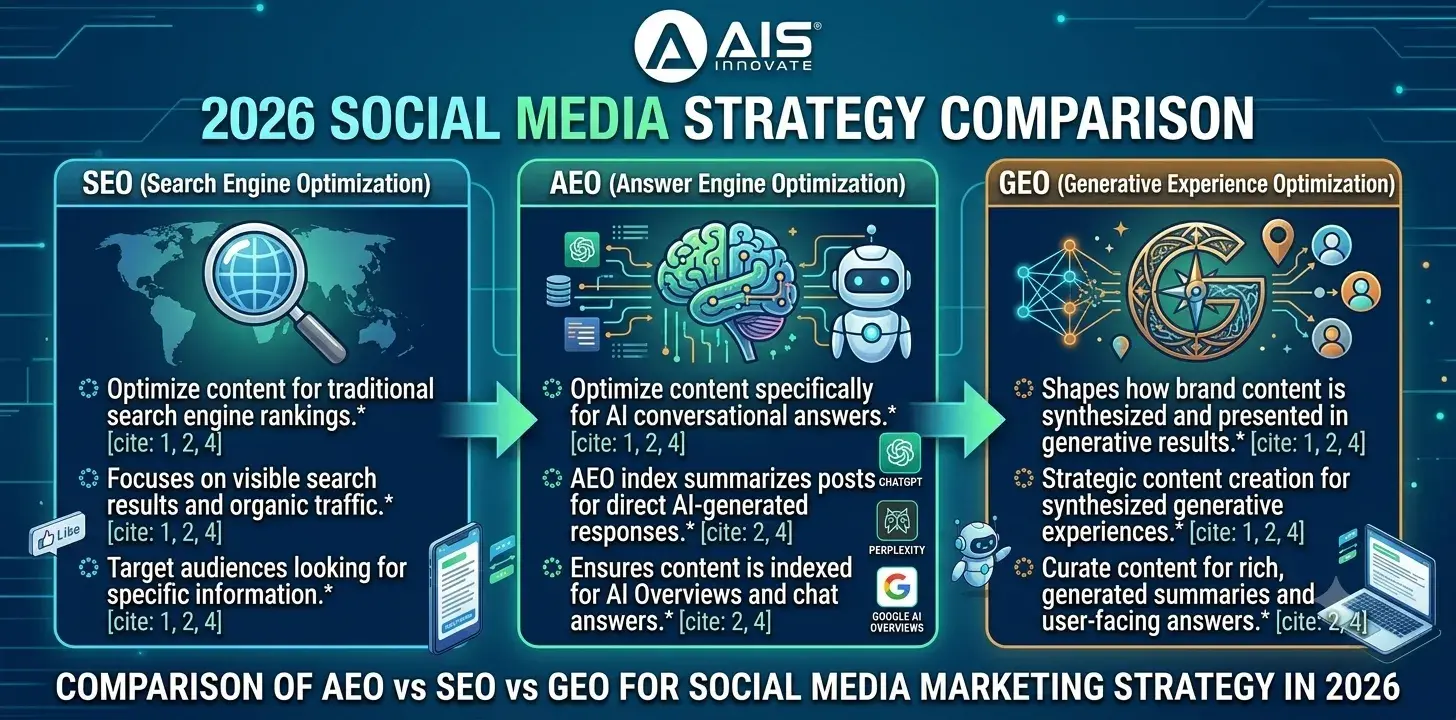
AEO stands for Answer Engine Optimization. It is the discipline of creating content that AI systems can use to directly answer user queries. Traditional SEO focuses on ranking in search results. AEO focuses on being the answer itself — the text or data an AI quotes when a user asks a question.
Applied to social media, AEO means writing posts so that platforms like TikTok, Instagram, LinkedIn, and YouTube — and the AI tools that crawl them — can understand, extract, and surface your content as a reliable answer.
| Dimension |
SEO |
AEO |
GEO (Generative Engine Optimization) |
| Primary Goal |
Rank in search results |
Be the direct answer |
Be cited in AI-generated content |
| Target Audience |
Search engine crawlers |
Answer engines (ChatGPT, Perplexity) |
LLMs generating summaries |
| Content Format |
Long-form articles, meta tags |
Q&A, structured snippets |
Authoritative data, expert quotes |
| Social Media Role |
Secondary (links, signals) |
Primary (posts as answers) |
Primary (cited as sources) |
| Measurement |
Rankings, clicks, impressions |
AI citation frequency |
Brand mentions in AI outputs |
All three disciplines overlap. The most effective social media strategy in 2026 applies all three simultaneously.
AEO, SEO, and GEO work as three complementary layers of a modern AI search strategy. To understand how GEO specifically differs from traditional SEO and get actionable optimization tactics, read our complete guide:
How to Optimize Your Website for AI Search Engines (GEO vs. SEO).
The scale of AI-driven search is now impossible to ignore. According to Hootsuite's 2026 Social Trends Report, social media platforms are evolving from communication channels into search engines, research labs, and high-stakes creative testing grounds. AI tools are reading this shift and acting accordingly.
Key Statistics
- ChatGPT now reaches 883 million monthly users. Google AI Overviews appear in nearly 55% of all Google searches. (Source: Frase.io, 2026)
- AI-referred sessions to websites grew 527% year-over-year through mid-2025. (Source: Frase.io, 2026)
- Gartner predicts 25% of organic search traffic will shift to AI chatbots and virtual assistants by 2026. (Source: CXL, 2026)
- HubSpot's own AEO strategy produced a 1,850% increase in qualified leads, and AEO beta customers drove 20% more traffic from AI. (Source: HubSpot, 2026)
- 42% of CRM software buyers now use AI search as part of their evaluation process. (Source: HubSpot, January 2026)
- Approximately one-third of consumers now skip traditional search entirely, preferring TikTok, Instagram, or YouTube for discovery. (Source: LocaliQ, 2026)
- 64% of small businesses cited social media as their primary traffic driver — surpassing organic search at 52%. (Source: Coalition Technologies, 2026)
- Hootsuite's 2026 Social Trends Report identifies social-as-search and AEO as two of the most critical optimization layers for brands.
Google's algorithm is now tightly connected to AI search behavior. The Google May 2026 Core Update specifically rewarded content structured for AI discovery — making AEO a direct ranking factor, not just an emerging trend. See the full impact breakdown:
Google May 2026 Core Update: Everything You Need to Know.
When an AI tool answers 'What are the best social media marketing strategies for B2B brands?' it pulls from sources it considers credible, structured, and comprehensive. Your social post — if properly optimized — can be one of those sources.
Understanding how AI tools process social content is the first step to optimizing for them. LLMs do not read posts the same way humans do. They look for specific signals.
How AI Answer Engines Retrieve Content: The RAG Pipeline
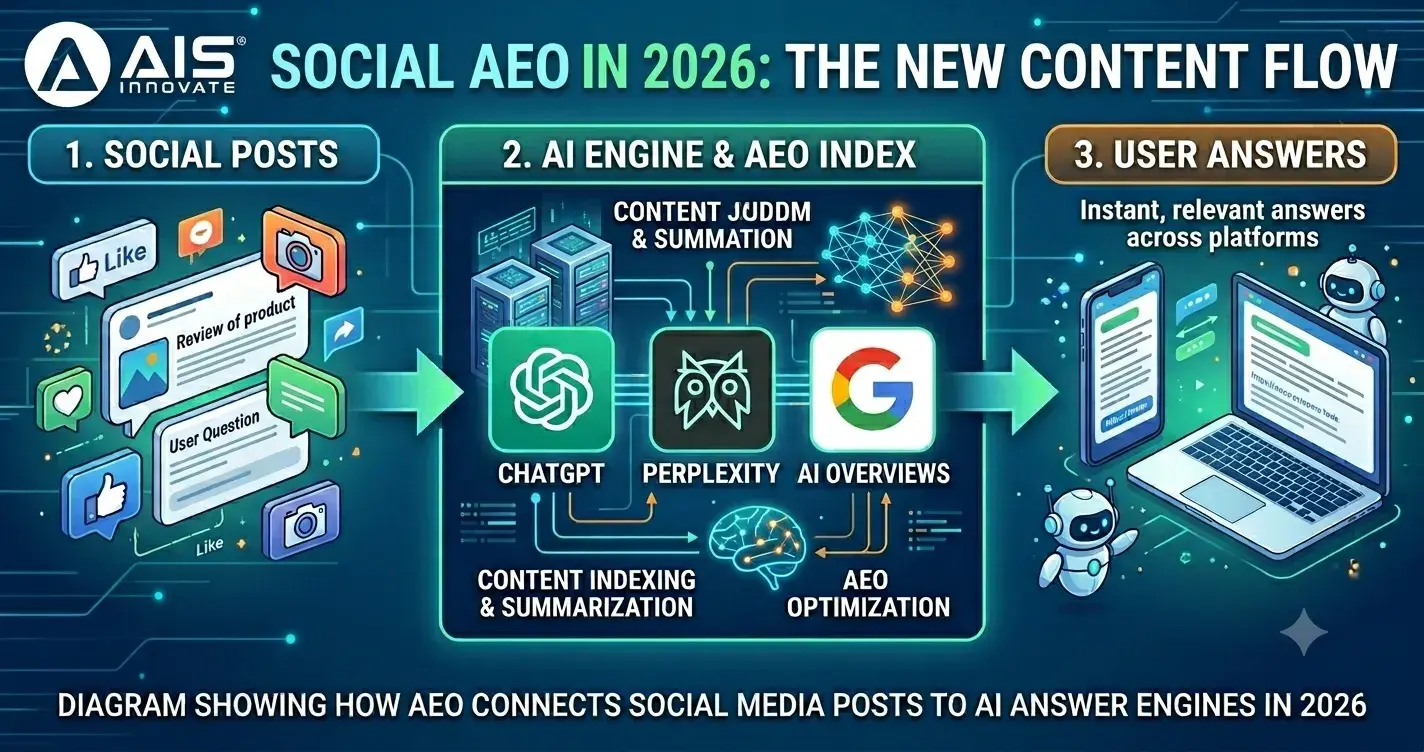
AI answer engines use a process called Retrieval-Augmented Generation (RAG) to find, evaluate, and cite content. Understanding RAG is essential for AEO because each stage is an optimization opportunity.
- Stage 1 — Query Interpretation: The AI parses the user's question and converts it into a semantic search request. Plain-language keywords in your post help the AI match your content to the query.
- Stage 2 — Retrieval: The AI scans indexed content across the web — including social posts, blog pages, and platform descriptions — looking for relevant passages.
- Stage 3 — Evaluation: The AI scores retrieved content for clarity, credibility, and completeness. Structured formats, statistics, and standalone sentences score highest.
- Stage 4 — Generation: The AI synthesizes a final answer, citing the most trusted sources. This is where your social post either gets cited — or gets skipped.
Optimizing for RAG means writing content that passes all four stages. A vague caption fails at Stage 1. A post with no data fails at Stage 3. A wall of text with no structure fails at Stage 4.
What AI Answer Engines Prioritize
- Clarity of topic: The post must state its subject immediately. Vague or ironic captions fail AI extraction.
- Standalone completeness: Each post should answer one question fully without requiring context from a thread.
- Plain-language keywords: AI tools match buyer language. 'How to increase Instagram engagement for B2B brands' works better than 'levelling up your gram game.'
- Structured format: Lists, numbered steps, and Q&A formats are easy for LLMs to parse and cite.
- Credibility signals: Data, statistics, named sources, and expert quotes increase the probability of citation.
- On-screen text in video: AI tools trained on video captions and subtitles can extract spoken and on-screen text from Reels, Shorts, and TikToks.
Hootsuite's 2026 Social Trends Report notes that social marketers should be thinking about AEO — short social posts that directly answer questions benefit from Answer Engine Optimization just as much as long-form blog content.
1. Write One Answer Per Post
Each post should answer one search query completely. Do not try to cover multiple topics. AI tools extract single, clean answers.
- Bad: 'Social media is changing fast. AI, video, community — it is all happening now. What does this mean for your brand?'
- Good: 'The top social media trend for B2B brands in 2026 is LinkedIn short-form video. It drives 3x more engagement than static posts for professional audiences.'
2. Start Every Caption With the Answer
Place the core answer in the first line of every caption. AI tools often extract the opening sentence. Users scanning feeds need the payoff immediately.
- Answer first: 'The best time to post on LinkedIn for B2B is Tuesday to Thursday, 9am–11am in your audience's timezone.'
- Then add context, data, and a call to action.
3. Use Buyer-Language Keywords in Captions and On-Screen Text
Keyword research is not just for blogs. Social captions, video titles, and on-screen text should include the exact phrases your audience searches for.
Examples of buyer-language keywords for a social media marketing agency:
- 'social media strategy for small business'
- 'how to increase Instagram followers organically'
- 'best social media platforms for B2B marketing'
- 'social media ROI measurement tools'
Implementing AEO across multiple social platforms manually is time-consuming. AI workflow automation tools can handle content scheduling, caption optimization, and performance tracking automatically — so your posts are always structured for AI extraction. See how:
How AI Workflow Automation is Transforming Digital Marketing.
4. Add FAQ-Style Posts to Your Content Calendar
Question-and-answer posts are one of the highest-performing AEO content formats for social media. They mirror exactly how users query AI tools.
- Post title: 'Q: What is the difference between organic and paid social media?'
- Caption answer: 'A: Organic social media means content you publish without paying for distribution. Paid social means sponsored posts and ads that reach targeted audiences beyond your followers. Most brands in 2026 need both.'
5. Use Structured Formats: Lists, Steps, and Comparisons
AI tools parse structured content faster than prose paragraphs. Use numbered lists for process posts, bullet lists for tips, and comparison tables in carousel posts.
- '5 steps to audit your social media strategy'
- '3 reasons LinkedIn outperforms Facebook for B2B leads'
- 'Instagram vs TikTok for brand awareness: a data comparison'
6. Optimize Video Content for AI Extraction
Short-form video is dominant in 2026, and AI tools can now extract text from video captions, subtitles, and on-screen text. Treat your video like a blog post.
- Speak the keyword clearly in the first five seconds.
- Add accurate subtitles — these are indexed by platforms and AI tools.
- Include on-screen text that restates the core answer.
- Use video descriptions as mini-blog summaries with keywords.
7. Build Entity Signals Across Your Social Profiles
AI engines do not just match keywords. They identify entities — people, organizations, products, concepts, and the relationships between them. This is the foundation of GEO (Generative Engine Optimization).
An entity is how an AI tool recognizes your brand as a real, trustworthy subject — not just a collection of keywords. The more consistently your brand identity appears across platforms, the stronger your entity signal becomes.
- Use your exact brand name consistently across all social bios, handles, and descriptions.
- Include your location, service category, and industry in every platform profile.
- Link your social profiles to your website and Google Business Profile.
- Mention your brand name naturally within post captions — not just in hashtags.
- Get mentioned by other credible accounts, publications, and industry communities — these third-party mentions strengthen your entity recognition in AI systems.
Entity optimization is why two brands with identical post quality can get very different AI citation results. The brand with stronger entity signals — consistent name, location, service descriptions, and cross-platform presence — wins the citation.
✅ AEO SOCIAL MEDIA OPTIMIZATION CHECKLIST — Use this before publishing every post.
- State the topic clearly in the first line of the caption.
- Use one exact buyer-language keyword per post.
- Answer one question completely — no half-answers.
- Keep sentences under 20 words for easy AI extraction.
- Add keyword to on-screen text in video (not just the caption).
- Include a data point or statistic for credibility.
- Use a list or numbered format for process-based content.
- Write captions that stand alone — no context required.
- Add accurate subtitles to all video content.
- Include a clear CTA that drives the user to a landing page or resource.
- Keep brand name, bio, and service descriptions identical across all platforms (entity signals).
- Understand the RAG pipeline — write content that passes all 4 stages: query match, retrieval, evaluation, generation.
Mistake 1: Vague Captions That Hide the Topic
Problem: 'This is something every marketer needs to know right now...' — AI cannot extract an answer from mystery-style hooks.
Fix: Lead with the answer. 'Here is the #1 social media mistake that reduces organic reach in 2026: posting without keyword-rich captions.'
Mistake 2: Relying on Hashtags as Keywords
Problem: Hashtags alone do not tell AI tools what your post is about. #socialmedia is too broad.
Fix: Write the keyword into the caption text naturally. 'Social media marketing for e-commerce brands requires a different strategy than B2B marketing.'
Mistake 3: Video Content With No Captions or On-Screen Text
Problem: AI tools cannot extract meaning from video audio alone without transcription data.
Fix: Always add subtitles to videos. Add on-screen text that states the key answer. Write a keyword-rich video description.
Mistake 4: Writing for Likes, Not for Answers
Problem: Engagement-bait posts ('Tag someone who needs to see this!') have zero AEO value.
Fix: Balance engagement tactics with answer-first content. Your content calendar should include at least 30% FAQ-style or how-to posts optimized for AI extraction.






 11 March 2024