Key Takeaways:
⚡ Quick Key Takeaways
- 88% of organisations surveyed by McKinsey regularly use AI in at least one business function (State of AI, 2025)
- AI automation handles repetitive tasks so your team focuses on strategy and creativity
- Top impact areas: social media, email, lead gen, paid ads, content, support & analytics
- No-code platforms make automation accessible even without a technical background
- Start with one workflow → measure → then scale across your marketing operations
- Human judgment remains essential — automate tasks, not thinking
- Measure each automated workflow against a baseline: hours saved, response time, cost per lead and conversion rate
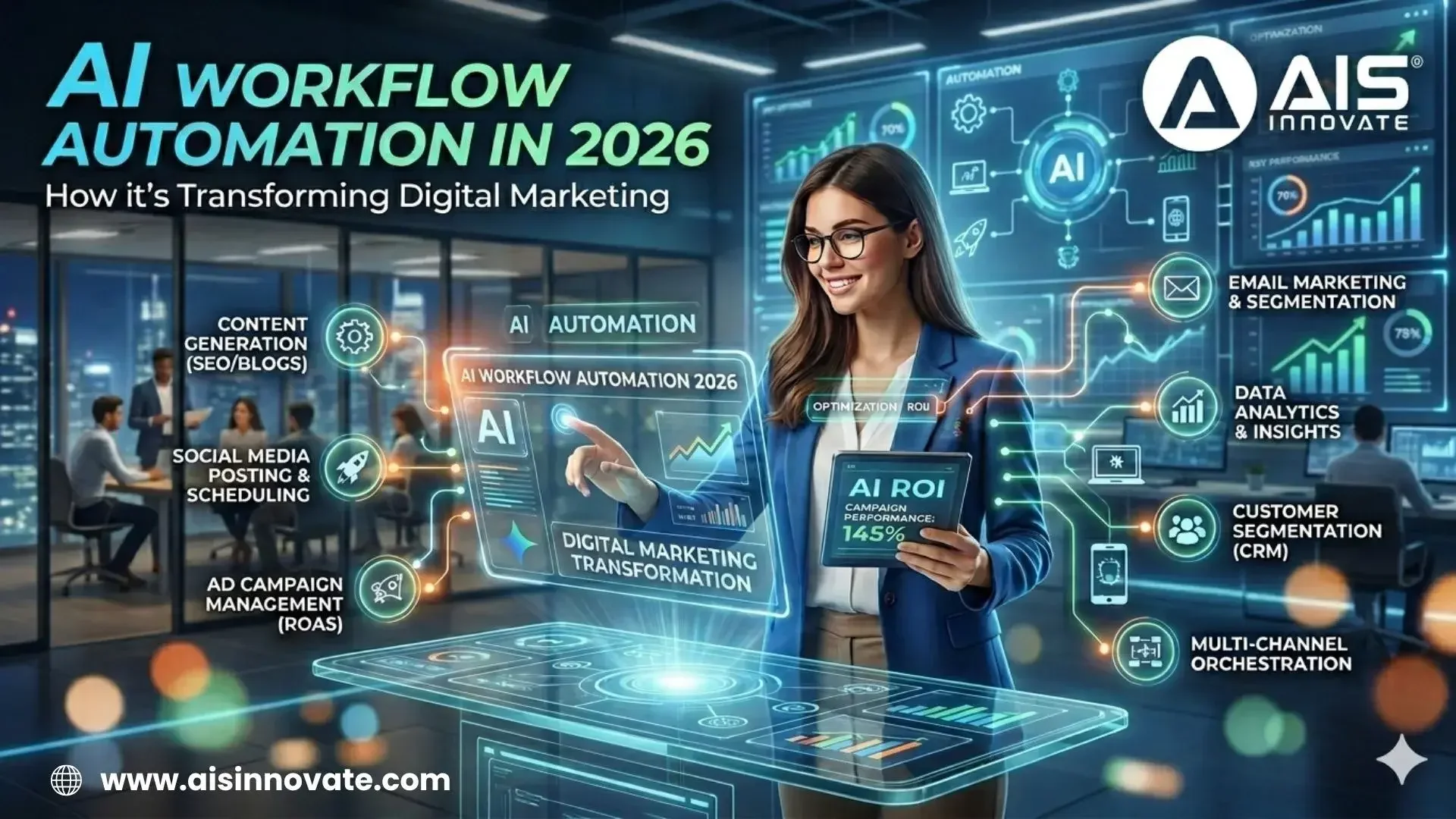
AI workflow automation in digital marketing uses artificial intelligence to run repetitive marketing tasks, such as scheduling posts, personalising emails, scoring leads and building reports, and to improve them from the results. Teams that automate the right workflows spend less time on manual work and more on strategy, creativity and growth.
AI workflow automation is at the center of this shift. It is changing how marketing teams plan campaigns, manage social media, generate leads, respond to customers, and measure results — all with less manual effort and far greater accuracy.
Whether you are a startup running lean or an enterprise scaling fast, understanding how AI automates marketing work is no longer optional. It is the difference between staying competitive and falling behind.
In this blog, we break down exactly what AI workflow automation means for
digital marketing services, where it is already making the biggest impact, what tools businesses are using, and how you can get started — even without a technical background.
Yes, when it is aimed at specific, measurable workflows rather than everything at once. AI-assisted marketing operations take over repetitive work such as reporting, scheduling and lead follow-up, respond to customers faster and personalise at scale. The gains show up in metrics you can track: hours saved, response time, cost per lead and conversion rate.
The condition is focus. Teams that see results start with one workflow, record a baseline before switching it on, and measure the same metric afterwards. The section on measuring impact below shows which metric to track for each workflow.
AI workflow automation refers to the use of artificial intelligence to automatically manage, execute, and optimize repetitive marketing tasks and processes — without constant human involvement.
Unlike traditional automation that follows fixed rules (if this, then that), AI workflow automation is intelligent. It analyses data, learns from patterns, makes decisions, and continuously improves over time.
In digital marketing, this means:
- Automatically scheduling and publishing social media content at peak engagement times
- Generating personalised email sequences based on user behaviour
- Routing leads to the right sales team the moment they come in
- Analysing campaign performance and suggesting optimisations in real time
- Responding to customer enquiries instantly through AI-powered chat
- In simple terms — AI workflow automation handles the repetitive, time-consuming parts of marketing so your team can focus on strategy, creativity, and growth.
The numbers make the case clearly. According to
McKinsey's State of AI 2025 survey, 88% of respondents say their organisations regularly use AI in at least one business function, up from 78% a year earlier.
Gartner predicted that by 2026 more than 80% of enterprises would have used generative AI APIs or models, or deployed generative AI applications in production, up from less than 5% in 2023.
But why is 2026 specifically such a turning point?
- The competition is moving faster
Brands that automate their marketing workflows can publish more content, respond faster, run more campaigns, and generate more leads — all at a lower cost than manual operations. What "lower" means in rupee terms depends on the mix of channels you run — our
breakdown of digital marketing service costs sets out the typical monthly ranges.
- Consumer expectations are higher
People expect instant responses, personalised experiences, and consistent brand communication across every platform. Manual marketing teams simply cannot keep up with this at scale.
No-code and low-code AI automation platforms mean that even small businesses and solo marketers can implement powerful workflows without needing a developer or a large budget.
The question is no longer whether to automate marketing workflows with AI. It is how quickly you can do it — and how well.
Managing social media manually across multiple platforms — Facebook, Instagram, LinkedIn, YouTube — is one of the most time-consuming tasks in digital marketing.
Automation changes this completely. AI tools can:
- Analyse your audience behaviour and schedule posts at optimal times automatically
- Generate content suggestions and captions based on trending topics in your industry
- Monitor all your social channels in one place and flag comments, mentions, or DMs that need a response
- Run A/B tests on post formats and automatically scale what works
The result is a consistent, high-quality social media marketing presence — managed in a fraction of the time. For a complete breakdown of tools and real-world examples, read our guide on
how to use AI in digital marketing.
Generic email blasts no longer work. Audiences today expect emails that feel relevant and personal.
AI-powered email workflows let marketers:
- Segment audiences dynamically based on real-time behaviour (website visits, clicks, purchases)
- Trigger personalised email sequences automatically based on specific user actions
- Predict the best send time for each individual subscriber
- Continuously optimise subject lines, content, and CTAs based on open and click data
Track open rate, click-through rate and revenue per email before and after switching on AI personalisation, so the gain is measured rather than assumed. To find the right platform for your business, see our full guide on the
best email marketing services for small businesses.
Lead generation is where automated AI workflows deliver some of their most powerful results.
From the moment a potential customer interacts with your brand — visiting your website, downloading a resource, filling a form — AI workflows take over:
- Scoring leads automatically based on behaviour and fit
- Routing high-intent leads instantly to the sales team
- Sending personalised nurture sequences to leads who are not yet ready to buy
- Following up at exactly the right moment without any manual effort
This means no lead falls through the cracks, and your sales team spends time only on the most qualified prospects.
Running paid campaigns on Google, Facebook, or LinkedIn manually is expensive and inefficient. AI-driven bidding and testing change this.
AI-powered ad platforms can:
- Automatically adjust bids in real time based on performance signals
- Identify the best-performing audiences and scale budgets toward them
- Generate multiple ad variations and test them simultaneously
- Pause underperforming ads and redistribute budget without human intervention
The impact is significant — lower cost per lead, higher return on ad spend, and campaigns that continuously improve without requiring daily manual management.
AI tools are now capable of assisting in content creation — from generating first drafts and blog outlines to repurposing long-form content into social posts, email newsletters, and short videos.
More importantly, AI workflow automation handles the distribution side — ensuring every piece of content reaches the right audience, on the right platform, at the right time — automatically.
AI-powered chatbots and automated support workflows are transforming how brands handle customer communication.
Modern AI chatbots can:
- Understand customer intent (not just keywords) and provide accurate, helpful responses
- Handle frequently asked questions, appointment bookings, and product queries 24/7
- Escalate complex issues to human agents with full context automatically
- Collect customer feedback and feed it back into your marketing data
This improves customer experience, reduces support costs, and ensures no enquiry goes unanswered — even outside business hours.
One of the most valuable applications of AI in marketing operations is turning raw data into actionable insights — automatically.
Instead of manually pulling reports from five different platforms and trying to make sense of the numbers, AI-powered analytics tools:
- Aggregate data from all your marketing channels in one dashboard
- Identify what is working and what is not — faster than any human analyst
- Predict future campaign performance based on historical data patterns
- Recommend specific actions to improve results
This means every marketing decision is backed by data — not guesswork.
LET'S DISCUSS YOUR IDEAS
Transform your online presence with result-driven digital marketing services. Let our team create customized campaigns that bring measurable growth to your business.
Get StartedHere is a quick overview of the most widely used AI workflow automation tools in digital marketing right now:
Tool | Best For |
HubSpot | Full marketing automation — email, CRM, lead nurturing |
Zapier / Make | Connecting apps and automating cross-platform workflows |
Hootsuite / Buffer | AI-assisted social media scheduling and analytics |
ChatGPT / Claude | Content drafting, ideation, and customer communication |
Jasper AI | AI-powered marketing copywriting at scale |
ActiveCampaign | Email marketing automation and customer journey mapping |
Manychat | Instagram and WhatsApp chatbot automation |
Surfer SEO | AI-driven SEO content optimisation |
AdEspresso | Automated paid social ad management and A/B testing |
n8n / Gumloop | No-code AI workflow builders for custom automations |
The right tool depends on your business size, budget, and which part of your marketing process you want to automate first.
Task | Done manually | With AI workflow automation |
Social posting | Someone schedules each post by hand | Posts are queued and published at each platform's best time |
Email follow-up | Sent in batches when someone has time | Triggered by each contact's own actions |
New leads | Checked and assigned during office hours | Scored and routed to sales the moment they arrive |
Ad budgets | Adjusted after a weekly review | Bids and budgets shift with live performance |
Reporting | Pulled from each platform into a spreadsheet | One dashboard updates itself |
Customer enquiries | Answered when the team is online | Common questions answered 24/7, complex ones passed to a person |
Social media is one of the highest-impact areas for AI-driven workflows, for businesses of all sizes.
Here is what a fully automated social media workflow looks like in practice:
- Step 1 — Content Planning: AI analyses trending topics, competitor activity, and past performance to suggest a content calendar for the month.
- Step 2 — Content Creation: AI assists in generating captions, hashtags, and visual briefs tailored to each platform's algorithm and audience.
- Step 3 — Scheduling and Publishing: Posts are automatically scheduled and published at the highest-engagement time for each platform — no manual posting needed.
- Step 4 — Community Management: AI monitors comments, DMs, and brand mentions across all platforms. Routine responses are handled automatically. Important messages are flagged for human review.
- Step 5 — Performance Tracking: AI tracks reach, engagement, follower growth, and conversions in real time — and automatically adjusts the strategy based on what the data shows.
This kind of fully automated workflow allows
social media marketing teams to manage more platforms, produce more content, and achieve better results — in significantly less time.
Whether you are a small business or a large enterprise, the benefits of automating your marketing with AI are clear:
- Save Time Automate repetitive tasks like posting, reporting, email scheduling, and lead follow-up — freeing your team for higher-value strategic work.
- Reduce Costs Do more with the same team size. AI automation reduces the need for manual effort across multiple marketing functions.
- Improve Consistency Never miss a post, a follow-up, or a report again. Automated workflows run reliably every single time.
- Personalise at Scale Deliver personalised experiences to thousands of customers simultaneously — something no manual team can do effectively.
- Make Smarter Decisions AI analyses your marketing data continuously and surfaces insights that humans would take days to find.
- Scale Without Proportional Costs As your business grows, AI workflows scale with you — without needing to proportionally increase your team size or budget.
Automation is powerful — but it is not without challenges. Here is what businesses typically face and how to address them:
- Challenge 1 — Choosing the Right Tools With hundreds of tools available, it can be overwhelming. Start with one area — social media, email, or lead nurturing — and master one tool before expanding.
- Challenge 2 — Data Quality AI is only as good as the data it works with. Ensure your CRM, analytics, and marketing platforms are set up correctly and feeding clean, consistent data.
- Challenge 3 — Over-Automation Automating everything without human oversight can damage your brand voice and customer relationships. The best approach is to automate the repetitive tasks while keeping human judgment in the strategy and creative layers.
- Challenge 4 — Team Adoption Introduce automation gradually and train your team. The goal is to make their work easier — not replace their expertise.
Keep people in charge of strategy, brand voice, the final approval of anything published or sent to customers, budget decisions above a set limit, and replies to complaints or sensitive enquiries. Let AI draft, schedule, sort, score and report; let people decide and approve.
If you are new to automating marketing with AI, here is a simple, practical starting point:
- Step 1 — Audit Your Current Marketing Processes List every repetitive task your marketing team does manually — posting on social media, sending follow-up emails, pulling reports, responding to common queries. These are your automation candidates.
- Step 2 — Prioritise by Impact Identify which of these tasks, if automated, would save the most time or generate the most revenue. Start there.
- Step 3 — Choose One Tool and Start Small Pick one area — social media scheduling, email automation, or lead nurturing — and implement one tool. Learn it. Measure the impact.
- Step 4 — Build and Connect Your Workflows Once one workflow is running well, connect it to others. For example, a lead captured via social media ad → automatically added to CRM → triggers a personalised email sequence → followed up by sales team when lead score reaches threshold.
- Step 5 — Monitor, Optimise, and Scale Review your automated workflows monthly. Identify what is performing, what needs adjustment, and where to expand automation next.
Measure each automated workflow against the baseline you recorded before switching it on, and track the same metric for at least 60 days so a short-term spike does not hide a long-term drop.
Workflow | What to measure |
Social media scheduling | Hours spent on posting each week; engagement rate per post |
Email personalisation | Open rate; click-through rate; revenue per email sent |
Lead scoring and routing | Time from enquiry to first response; lead-to-customer conversion rate |
Paid advertising optimisation | Cost per lead; return on ad spend |
Customer support chatbots | Share of enquiries resolved without a person; response time outside business hours |
Analytics and reporting | Hours spent building reports each month; time from data to decision |
Which AI solutions have the highest measurable impact? The ones attached to a number you already track. Lead routing, email personalisation and reporting are often the easiest to prove, because their metrics are recorded before and after automation.
AI-driven marketing automation is not a future trend. It is happening right now, and it is reshaping digital marketing at every level — from how brands manage social media to how they generate leads, nurture customers, and measure results.
Businesses that embrace automation in 2026 will move faster, spend smarter, and consistently outperform competitors who are still doing everything manually.
The key is to start smart — identify your highest-impact processes, choose the right tools, and build automation into your marketing foundation one step at a time.
At AIS Innovate, our
AI-powered digital marketing services help businesses build and run data-driven strategies, including the automated workflows described above. Whether you want to automate your social media, supercharge your lead generation, or build a fully integrated marketing workflow, our team is here to help.
LET'S DISCUSS YOUR IDEAS
Transform your online presence with result-driven digital marketing services. Let our team create customized campaigns that bring measurable growth to your business.
Get Started





 9 April 2026