



In This Article
- 01Introduction
- 02What Are Brand Development Services?
- 03Why Brand Development Matters More Than Most Businesses Assume
- 04Key Components of Professional Brand Development Services
- 05What a Proper Brand Development Process Looks Like
- 06The Benefits of Investing in Professional Branding Services
- 07Signs Your Business Needs Brand Development (Not Just a Redesign)
- 08Common Mistakes Businesses Make With Brand Development
- 09Final Thoughts
Key Takeaways:
Consistent brand presentation can increase revenue by 10–33%, according to Lucidpress/Marq's State of Brand Consistency Report.
Brand development covers strategy, identity design, messaging, research and digital assets — not just a logo.
A defined process (discovery, strategy, identity, guidelines, rollout) produces materially different results than ad hoc design work.
80% of consumers now trust brands they use more than institutions like government or media, making brand trust a measurable business asset.
Introduction
Brand development services are often confused with a single deliverable — a new logo, a colour palette, a slightly punchier tagline. In reality, they cover a far broader and more strategic process: defining who your business is, how it communicates, and how consistently that identity shows up everywhere a customer encounters it.
That distinction matters, because the businesses that treat branding as a one-off design task tend to get one-off results, while the ones that treat it as a strategic discipline see it compound. Below is a practical breakdown of what brand development services actually cover, what skipping them costs in lost revenue, and how to evaluate a partner properly.
What Are Brand Development Services?
A brand development company approaches branding as an ongoing strategic process rather than a single project. This typically includes defining your mission, core values, target audience, competitive positioning and messaging strategy, then translating that foundation into a visual identity and a set of guidelines that stay consistent across every customer touchpoint — your website, packaging, social presence, sales materials, and beyond.
The distinction between branding and brand development is worth being precise about. Branding usually refers to the visual and verbal identity itself — the logo, the colours, the voice. Brand development is the strategic work that determines what that identity should actually say and why, before any of it gets designed. It is the difference between a branding agency that starts with positioning and one that starts with mood boards.
Why Brand Development Matters More Than Most Businesses Assume
The financial case for this is better documented than most marketing claims. Consistent brand presentation can increase revenue by 10–33%, according to Lucidpress/Marq's State of Brand Consistency Report, a study surveying more than 400 brand management professionals. Separately, Edelman's Trust Barometer research found that 80% of consumers now trust brands they use more than they trust institutions like government or media — meaning a well-developed brand is functioning as a genuine trust asset, not just a visual preference.
A well-developed brand delivers several compounding advantages:
- Builds trust and credibility that shortens the path from first contact to purchase
- Increases recognition and recall, so marketing spend works harder over time
- Strengthens customer loyalty and repeat purchase behaviour
- Differentiates the business clearly from competitors offering similar products or services
- Supports long-term growth by giving every future marketing decision a consistent foundation to build on
Key Components of Professional Brand Development Services
1. Brand Strategy
This is the foundational layer everything else is built on — mission and vision, core values, competitive analysis, and a clearly defined unique selling proposition. Skipping this step is the most common reason branding projects produce something that looks polished but does not actually differentiate the business, which is why a brand strategy that drives growth is always defined before design begins.
2. Brand Identity Design
Once strategy is defined, brand identity services translate it visually — logo design, typography, colour palette, and a documented brand style guide that keeps every future designer or vendor consistent with the original strategy. This is where graphic design services turn positioning into something people can actually see.
3. Brand Messaging
Consistent messaging keeps your brand voice recognisable across every platform — taglines, elevator pitch, tone of voice, and the copy that appears on your website and in advertising. Messaging inconsistency is one of the fastest ways a brand starts to feel untrustworthy, even when the visual identity is strong, so content creation belongs inside the brand system rather than alongside it.
4. Audience and Market Research
Understanding your ideal customer in specific, evidence-based terms — not assumptions — is what allows a brand development company to tailor positioning, tone and visual style to the audience most likely to convert, rather than a generic middle ground that resonates with no one in particular. It is also what determines how a brand is actually perceived once it reaches the market.
5. Digital Presence and Brand Assets
Modern branding has to hold up across every digital surface a customer might encounter: website and interface design, social media templates, email design, and marketing collateral like brochures and business cards. A brand guideline that only covers print is incomplete for how most customers actually discover a business today.
What a Proper Brand Development Process Looks Like
A genuine brand development process typically moves through five stages, each building on the last:
- Discovery — understanding the business, its market and its competitors before any creative work begins
- Strategy — defining positioning, values, and the core strategic direction the brand will follow
- Identity design — translating strategy into a visual and verbal system
- Guidelines documentation — capturing rules so the brand stays consistent as new people and vendors get involved
- Rollout — implementing the brand consistently across every existing and new touchpoint
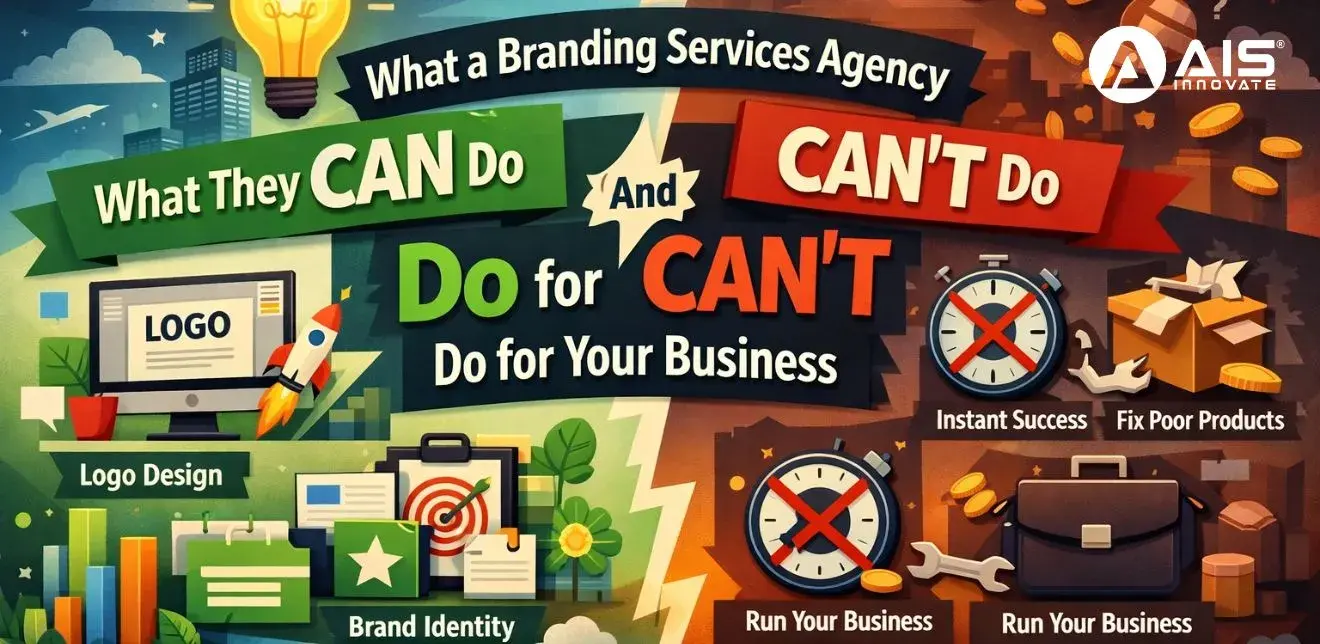
Agencies that skip straight from a discovery call to logo concepts are effectively skipping strategy — the result may look fine, but it is rarely built to differentiate the business or hold up as it grows. It is worth knowing in advance what a branding agency can and cannot do before you sign anything.
The Benefits of Investing in Professional Branding Services
Investing in professional branding services pays off in ways that compound over time rather than showing up as an immediate, single event:
Consistency Across Channels
A documented brand system means every new hire, vendor or agency produces on-brand work without needing to ask what is allowed — reducing both inconsistency and the time spent correcting it.
Increased Brand Equity
A recognisable, trusted brand becomes a genuine balance-sheet asset over time — one that supports premium pricing and makes the business more resilient to competitive pressure.
Faster Decision-Making
With strategy and guidelines already defined, decisions about new campaigns, products or channels move faster because the underlying direction does not need to be re-litigated each time.
Better Marketing ROI
Consistent, well-positioned branding makes every other marketing channel — paid ads, content, social — more effective, since audiences are reinforcing the same brand impression rather than encountering a slightly different one each time. It is the reason branding and digital marketing services work better bought together than sequentially.
Signs Your Business Needs Brand Development (Not Just a Redesign)
A few patterns tend to signal that the issue is strategic, not just visual:
- Your messaging changes depending on who in the company is writing it
- Customers consistently misunderstand what your business actually does
- You are competing primarily on price because nothing else clearly differentiates you
- Your visual identity feels outdated compared to competitors, but you are not sure why customers are drifting
- Every new marketing hire wants to redesign something before they have understood the existing strategy
If several of these sound familiar, the underlying issue is usually strategic positioning, not simply an outdated logo — which is exactly what brand development, rather than a surface-level refresh, is built to fix.
Common Mistakes Businesses Make With Brand Development
- Starting with visual design before strategy is defined, producing a brand that looks good but does not differentiate
- Treating brand guidelines as a one-time document rather than something actively enforced across every team and vendor
- Rebranding reactively, in response to a single bad campaign or executive preference, rather than strategically
- Skipping audience research and designing for internal taste rather than the customers actually being targeted
- Underinvesting in messaging while overinvesting in visual identity, despite messaging inconsistency being one of the fastest ways trust erodes
Final Thoughts
In a market where trust and recognition compound over time, a brand is one of the few business assets that gets more valuable the more consistently it is managed. Whether you are building an identity from scratch or repositioning an established business, professional brand development services give you a foundation to grow from, rather than a design project to redo every few years.
Do not just build a business — build a brand people remember, trust and choose.
Ready to elevate your brand? Get in touch to discuss where to start, or see how this plays out in our recent branding work.
LET'S DISCUSS YOUR IDEAS
Build a brand people remember, trust and choose. Our team handles strategy, identity and rollout end to end.
Talk to Our Brand Team
 9 May 2025