


By AIS Innovate Team
Published:
Updated:
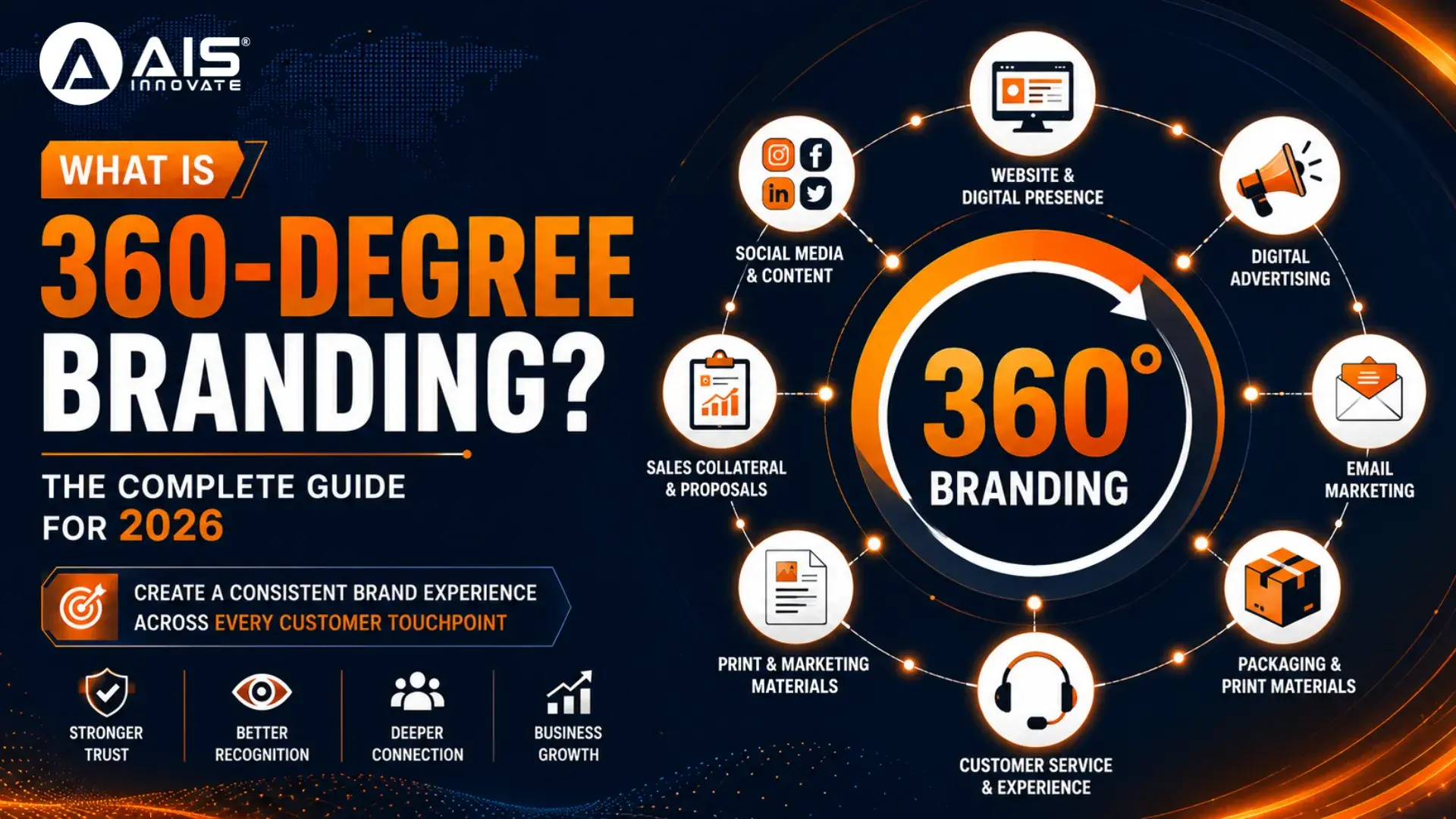
360-degree branding is a holistic brand strategy that ensures a business presents a consistent identity — visually,.
These two terms are often used interchangeably, but they describe very different things.
A 360 brand strategy maps and manages every major touchpoint.
You've invested in a logo. You have a website. Your business cards look sharp. So why do customers still struggle to recognise your brand?
The answer, in most cases, isn't a design problem. It's a consistency problem — and 360-degree branding is how you fix it.
In 2026, the businesses winning on brand aren't just the ones with the prettiest logos. They're the ones whose customers get the same feel, tone, and visual experience whether they land on your website, scroll past your Instagram ad, or open your packaging for the first time. That seamless, all-channels-covered brand experience is what 360-degree branding delivers.
In this guide, you'll learn exactly what 360-degree branding means, how it differs from traditional brand identity, which touchpoints it covers, and how to know if your business needs it now.
360-degree branding is a holistic brand strategy that ensures a business presents a consistent identity — visually, verbally, and experientially — across every customer touchpoint.
The term "360 degrees" represents a full circle: no gap, no channel left unbranded, no inconsistency between platforms. Whether a customer finds your business on Google, scrolls past your Instagram ad, receives a proposal from your sales team, or opens your product packaging for the first time, the experience should feel seamless and unmistakably yours.
It is the most comprehensive approach to building a brand, and it goes far beyond logos or colour palettes.
A brand touchpoint is any point of contact between your business and a potential or existing customer. This includes:

Your website and landing pages
Social media profiles and content
Paid advertising (Google, Meta, LinkedIn)
Email communications
Product packaging and physical materials
Business cards, brochures, and signage
Customer service interactions
Proposals, pitch decks, and sales collateral
In-person events and trade show presence
Every single one of these is either building your brand — or subtly undermining it.
These two terms are often used interchangeably, but they describe very different things.
| Brand Identity | 360-Degree Branding | |
|---|---|---|
| What it is | The visual system: logo, colours, typography | The full brand strategy applied across all channels |
| Scope | Asset-level | Strategy-level |
| Output | Brand guidelines document | Brand experience delivered consistently everywhere |
| Who uses it | Designers, creative teams | The whole business |
| Goal | Define how the brand looks | Ensure the brand feels consistent everywhere |
| Covers | Visual identity only | Visual + verbal + experiential brand |
The simplest way to understand the difference:
Brand identity is the toolkit. 360-degree branding is how you use that toolkit everywhere your customers find you — without exception, without variation, without compromise.
A 360 brand strategy maps and manages every major touchpoint. Here are the eight that matter most:
Your logo, colour palette, typography, icon set, and imagery guidelines. This is the foundation — not the finish line. Everything downstream must reference and follow this system.
Your website is usually the first place a prospect forms an opinion about your brand. Design system, tone of voice in copy, page structure, page speed, and even button text all signal whether you're a business worth trusting.
Brand consistency on social means far more than using the same logo as a profile picture. Caption style, content format, visual editing style, posting cadence, and community engagement tone all need to reflect the same brand identity.
Every Google Ad, Meta campaign, and LinkedIn sponsored post is a brand touchpoint. Ad creative developed in isolation — without referencing brand guidelines — is one of the most common and damaging sources of brand inconsistency.
From automated transactional emails to full marketing campaigns, email is a direct line to your audience. On-brand templates, consistent voice, and professional design at every send raise brand perception without additional spend.
For product businesses, packaging is often the highest-impact brand moment — the unboxing experience is a branded interaction. For service businesses, print collateral (brochures, proposals, business cards) carries your brand into offline environments.
How your team communicates with customers — from first enquiry through to onboarding and ongoing support — is part of your brand. Brand voice guidelines must extend beyond marketing and into every customer-facing conversation.
Pitch decks, proposals, case study documents, and contract templates are often seen by high-value prospects before anything else. A polished, branded sales asset signals professionalism before a word is spoken.
The business case for 360-degree branding has strengthened significantly over the past two years. Here are the four most important reasons:
The average B2B buyer researches across 6–10 channels before making a purchasing decision. They'll see your LinkedIn content, visit your website, check your Google reviews, look at your Instagram, speak with your sales team, and open a proposal — often before they've had a single conversation. Each of those moments is a chance to build trust, or erode it.
Google AI Mode (launched May 2025, now available in 180+ countries), ChatGPT Search, and Perplexity are answering questions about your business before users even reach your website. These AI systems preferentially surface businesses with clear, consistent brand signals — unified naming, structured content, and coherent entity definitions. A fragmented brand sends confused signals to AI systems and is less likely to be cited. Google's May 2026 core update pushed in the same direction, rewarding content that is clear, accurate, and well-structured.
In competitive markets like the UK, UAE, and USA, every category is crowded. Consistent, professionally executed 360 branding cuts through visual noise and builds the kind of brand recognition that reduces customer acquisition cost over time — because people already know who you are before they need you.
Research consistently shows that brand inconsistency actively reduces buyer confidence. A premium website followed by a plainly designed email is a trust leak. An Instagram grid that looks nothing like your website creates subconscious doubt. In 2026, inconsistency isn't just aesthetically unpleasant — it costs you customers.
Not sure whether 360 branding applies to your business right now? These are the most common signals:
Your logo looks different across channels. Multiple versions, colours, or sizes appearing across your website, social media, signage, and printed materials are the clearest sign of a fragmented brand.
Customers describe your business differently to each other. If different customers use wildly different language to explain what you do, your positioning and messaging aren't landing consistently.
Your design assets were created by multiple people over multiple years. This almost always creates visual fragmentation — different styles, fonts, and approaches that don't feel like one brand.
Your ads look nothing like your website. One of the most common and damaging gaps: paid ad creative developed without reference to the brand, leading to a disjointed experience between click and landing page.
You've rebranded but the old brand keeps resurfacing. Outdated logos on old proposals, image caches on third-party directories, team signatures that haven't been updated — brand refresh without a 360 rollout plan is a half-done job.
You're expanding into new markets. Scaling into the UK, UAE, or US market with an inconsistent brand is a credibility risk. High-value decision-makers in those markets have high standards. A polished 360 brand signals readiness for the room.
Building a proper 360-degree brand strategy is a structured process, not a single design sprint. Here are the four stages:
Before any design begins, the strategic foundation must be clear.
Brand purpose — why the business exists beyond profit
Brand positioning — where you sit in the market relative to competitors
Target audience — who you're speaking to, what they care about, how they make decisions
Tone of voice — how your brand communicates: formal or conversational, technical or plain-English
Key messages — the three to five things your brand always communicates, regardless of channel
With strategy confirmed, the visual system is built:
Logo design (primary, secondary, icon versions)
Colour palette with exact hex, CMYK, and Pantone references
Typography system (primary + secondary typefaces, scale)
Icon and illustration style
Photography and imagery direction
Motion and animation principles (for digital)
The visual and verbal identity is then applied consistently across every touchpoint: website design, social media templates, email design system, packaging, print collateral, pitch decks, advertising templates, and signage. This is where 360 branding comes to life.
A 360 branding strategy only delivers value if it's maintained. Detailed brand guidelines — covering usage rules, do's and don'ts, and approved asset libraries — ensure the brand stays consistent as the business grows, hires new people, and works with external partners.
A 360 brand approach from day one gives startups an unfair advantage. When a new business looks established and consistent from launch, potential customers assume competence. Building the brand right before scaling saves enormous cost and rework later.
Businesses that have been trading for years without a cohesive brand strategy often have a significant gap between how they want to be perceived and how customers actually experience them. A 360 branding project can close that gap and position the business for its next phase of growth.
Expanding into the UK, UAE, or US market with a fragmented or underdeveloped brand is a real credibility risk. Decision-makers in these markets are used to seeing polished, consistent brands. A 360 brand signals that your business is ready for that environment.
READY TO BUILD YOUR 360 BRAND?
Get a unified brand experience across every touchpoint — from logo to website to campaign creative.
Talk to Our Branding Team
-


James Smith, MD, Cyclone Solutions
We are pleased with the AIS Innovate team. They have made our new website looks professional and user-friendly. They have tripled the number of leads per day; I highly recommend them for SEO and SMM.

 15 February 2025