Key Takeaways:
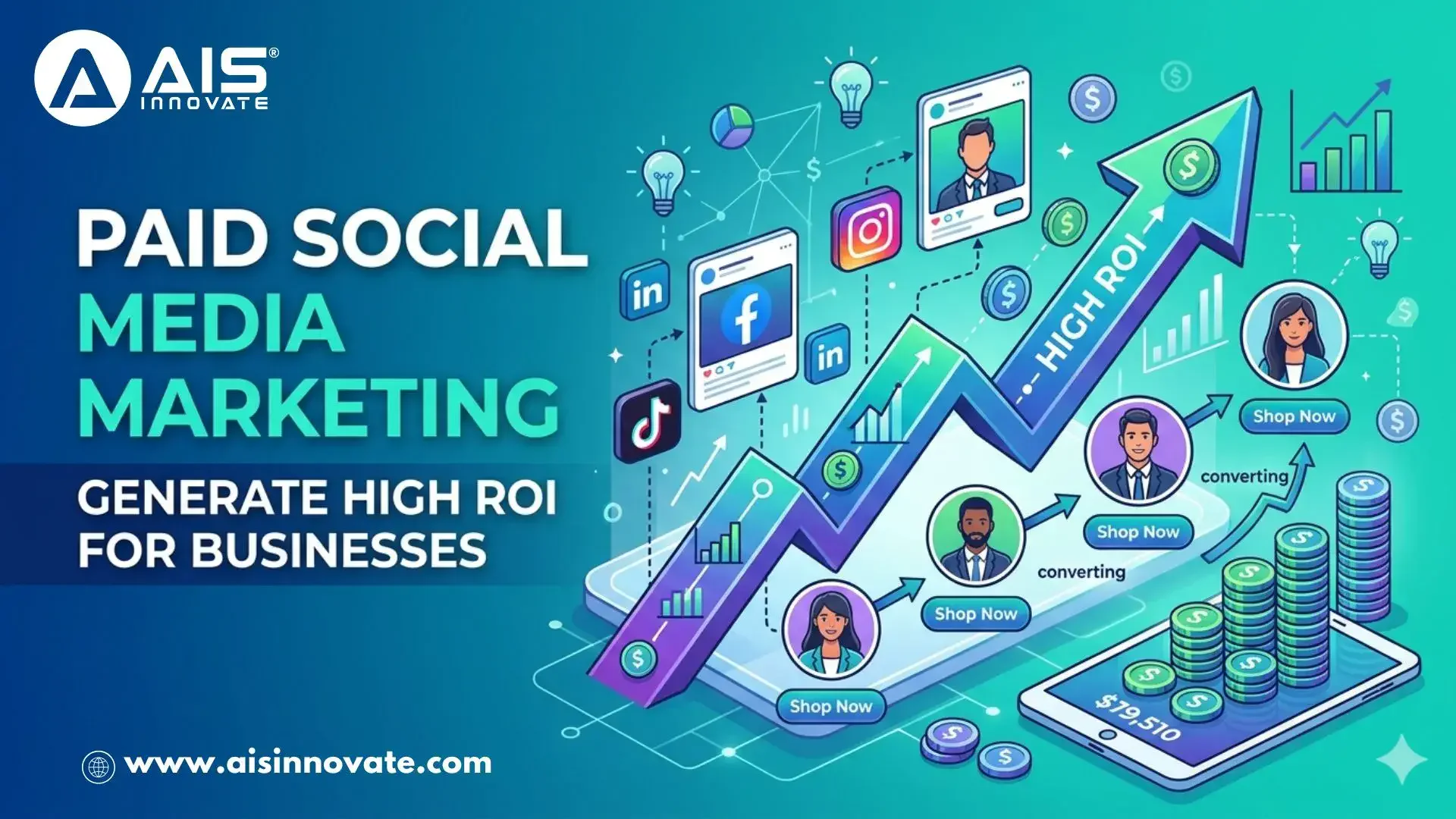
- Organic reach on Facebook and Instagram has dropped to as low as 2–6% — paid social is now the reliable way to reach your own audience.
- ROI from paid social depends on four things working together: precise audience targeting, scroll-stopping creative, matched landing pages, and airtight conversion tracking.
- A full-funnel audience strategy — cold, warm, and retargeting layers — consistently outperforms broad single-audience campaigns.
- Platform strengths differ: Meta suits B2C and local businesses, LinkedIn wins for B2B, TikTok leads for the 18–35 demographic, and Pinterest drives high purchase intent in retail and lifestyle.
- E-commerce brands with optimized funnels can realistically target 3x–6x return on ad spend; lead gen campaigns should benchmark cost per lead against actual customer lifetime value.
- White label social media management is explained as a viable option for agencies expanding into paid social without in-house expertise.
- Four common mistakes that quietly drain campaign ROI — including scaling too fast and optimizing for vanity metrics — are covered with practical fixes.
Every business owner has heard some version of this story: a brand spends thousands of dollars on social media posts, gets a handful of likes, and walks away convinced that social media marketing just doesn't work. What were they actually doing wrong? They were relying entirely on organic reach — a shrinking, unpredictable channel — when the real growth engine was sitting right there, untapped.
Paid social media marketing changes the math completely.
When you put budget behind your social strategy, you stop gambling on the algorithm and start buying precision. You reach exactly who you want, when you want, with a message crafted specifically for them. And when it's done right, the return on investment isn't just positive — it's measurable, scalable, and repeatable.
This guide breaks down exactly how paid social delivers ROI, what makes campaigns genuinely profitable, and why working with experienced social media marketing services often makes the difference between a campaign that limps along and one that drives real business results.
At its core, paid social media marketing means paying a platform — Meta, LinkedIn, TikTok, Pinterest, X (formerly Twitter) — to distribute your content to a defined audience. Unlike a boosted post (which is basically throwing money at whatever you've already published), a proper paid social campaign is built from the ground up with strategy baked in.
You're defining your audience before you write a single line of copy. You're choosing the right objective — awareness, traffic, leads, conversions — before you pick a format. You're setting up proper tracking so you know, to the dollar, what your campaign actually returned.
LET'S DISCUSS YOUR IDEAS
Transform your online presence with result-driven digital marketing services. Let our team create customized campaigns that bring measurable growth to your business.
Get Started
Meanwhile, paid social platforms have grown remarkably sophisticated. Meta's ad platform, for example, now uses AI-driven delivery optimization that continuously learns which users within your target audience are most likely to take your desired action. TikTok's algorithm, originally built for content discovery, has translated that same logic into its advertising engine. LinkedIn's Campaign Manager lets B2B brands target by job title, seniority, company size, and industry simultaneously.
The result? Paid social, when managed correctly, can reach audiences that are both larger and more relevant than anything organic will deliver — and it does so consistently, not just when the algorithm feels generous.
ROI doesn't happen by accident. There are specific elements that separate campaigns that pay for themselves (and then some) from campaigns that burn through budget with little to show for it.
1. Audience Precision Is Everything
The single biggest driver of paid social ROI isn't creative — it's targeting. Platforms give you an enormous range of options: demographics, interests, behaviors, lookalike audiences built from your existing customer list, and retargeting audiences made up of people who've already interacted with your brand.
Businesses that skip the targeting strategy and go broad end up paying to show ads to people who have zero interest in what they're selling. That's money straight down the drain.
The smartest campaigns layer their audiences. Cold audiences (people who've never heard of you) get awareness-focused messaging. Warm audiences (website visitors, video viewers, email subscribers) get retargeting ads that push toward a decision. Past customers get upsell and loyalty messaging. Each layer serves a different purpose, and together they create a full-funnel system that compounds over time.
2. Creative That Stops the Scroll
People on social media are not there to see ads. They're there to be entertained, informed, connected. Your ad has roughly 1.5 to 2 seconds to earn their attention before they scroll past.
High-performing creative in 2026 doesn't look like a brochure. It looks like content. Short-form video — particularly content that leads with the payoff rather than a slow build — consistently outperforms static images across most verticals. User-generated content (UGC) styles, which mimic organic posts from real customers, have become one of the most effective formats on both Meta and TikTok.
The brands generating the strongest ROI from paid social treat creative as a data problem. They run multiple variants simultaneously, they kill losing ads quickly, and they reinvest budget into what's working. It's iterative, not set-and-forget.
3. Landing Pages That Match the Promise
This is where enormous amounts of paid social ROI quietly bleed away. Someone sees a compelling ad, clicks through, lands on a generic homepage, can't find what the ad promised, and leaves. That click just cost you money and delivered nothing.
High-converting paid social campaigns send traffic to purpose-built landing pages that directly reflect what the ad said. Same offer, same imagery, same headline — and one clear action for the visitor to take. Conversion rate optimization at the landing page level can double the ROI of a campaign without changing a single thing about the ads themselves.
4. Proper Tracking and Attribution
You can't improve what you can't measure. Yet a surprising number of businesses running paid social have broken or incomplete tracking, meaning they're making budget decisions based on bad data.
At minimum, you need Meta Pixel or equivalent platform pixels installed and verified, conversion events set up and firing correctly, and UTM parameters on every link so your web analytics can tie traffic to specific campaigns. More sophisticated setups use server-side tracking and multi-touch attribution models to account for the messy reality that customers rarely convert on the first interaction.
When your tracking is solid, you can see exactly which campaigns, ad sets, and individual creatives are generating revenue — and you can scale the winners with confidence.
Different platforms serve different business objectives, and understanding where to invest is part of what makes professional social media marketing work.
Meta (Facebook & Instagram) remains the most flexible platform for most businesses — particularly those in B2C, e-commerce, and local services. The combination of massive reach, detailed targeting, and a mature ad ecosystem makes it the default starting point for most campaigns. Average cost per click varies widely by industry, but businesses with well-optimized funnels routinely achieve 3x to 5x return on ad spend.
LinkedIn is the platform of choice for B2B companies, especially those selling to mid-market and enterprise buyers. Targeting by job function and company size is unmatched anywhere else. The trade-off is cost — LinkedIn CPCs are significantly higher than Meta — but for the right offer (high-ticket services, software, professional training), the lead quality more than justifies the spend.
TikTok has matured rapidly as an ad platform. Brands in the 18–35 demographic space, particularly those in fashion, beauty, food, and consumer tech, are seeing some of the strongest organic-like engagement from paid TikTok content. UGC-style creative performs especially well here.
Pinterest is often overlooked, but for retail, home décor, food, and wedding-adjacent industries, it drives purchase intent that rivals Google Shopping. Users on Pinterest are in a planning mindset — they're actively looking for ideas to act on.
Here's a situation that comes up constantly in the agency world: a digital marketing firm lands a client who needs paid social, but the agency's core expertise is in SEO or web development. They have two options — turn down the work or try to figure it out themselves and risk the client's budget while they learn.
White label social media management offers a third, smarter option.
With a white label arrangement, a specialized paid social team does the actual campaign work — strategy, setup, creative briefing, optimization, reporting — while it's all delivered under the agency's own brand. The client sees professional social media marketing. The agency maintains the relationship and the margin. Everyone wins.
For businesses evaluating agencies, understanding whether their potential partner uses white label services isn't necessarily a red flag — it depends entirely on the quality of the team doing the work. What matters is accountability, transparency in reporting, and results.
Working with a specialist agency rather than running paid social in-house makes a significant difference for most small and mid-sized businesses. Here's the honest reason why: paid social platforms are complex and constantly changing. Meta alone rolls out significant algorithm and interface updates multiple times per year. Keeping up with that as a side responsibility while running a business is genuinely difficult.
Good social media marketing agencies bring three things that are hard to replicate internally:
Accumulated data
Agencies running campaigns across dozens of clients in similar industries have a huge advantage — they've already seen what works and what doesn't. They're not learning on your budget.
Dedicated tooling
Professional agencies use software for creative testing, audience analysis, bid management, and reporting that isn't available or practical for most in-house teams to purchase and maintain.
Optimization velocity
A dedicated team can review performance daily, make creative swaps weekly, and adjust targeting based on real-time signals. An in-house marketer managing ten other responsibilities realistically can't.
The result, for businesses that choose the right agency partner, is a paid social program that continuously improves — driving down cost per acquisition over time while scaling the volume of results.
LET'S DISCUSS YOUR IDEAS
Transform your online presence with result-driven digital marketing services. Let our team create customized campaigns that bring measurable growth to your business.
Get StartedSpecifics matter more than generalizations here, because ROI varies enormously by industry, offer, audience, and funnel. That said, some benchmarks help set reasonable expectations.
For e-commerce brands with a well-optimized funnel, a return on ad spend (ROAS) of 3x to 6x is achievable — meaning every $1 in ad spend returns $3 to $6 in revenue. Brands in highly competitive categories (fashion, consumer electronics) often start lower and scale up as their algorithms learn. Niche brands with strong organic audiences frequently beat these averages significantly.
For lead generation campaigns — service businesses, B2B companies, professional services — cost per lead is the more relevant metric. What a "good" cost per lead looks like depends on what a customer is worth. A business where each client relationship is worth $50,000 can afford a very different cost per lead than a business selling a $99 product.
The key is establishing your baseline numbers before you start: average order value or lifetime customer value, target cost per acquisition, and minimum acceptable ROAS. With those defined, campaign optimization has a clear direction.
Even well-resourced campaigns make these errors regularly.
Setting it and forgetting it.
Paid social is not a set-and-forget channel. Creative fatigue — when audiences have seen your ads enough times that they stop responding — typically sets in within 3 to 6 weeks for cold audiences. Regular creative refreshes aren't optional.
Optimizing for vanity metrics.
Likes, reach, and impressions feel meaningful but rarely correlate with revenue. Optimize for what actually matters: purchases, leads, sign-ups, and calls.
Scaling too fast.
When a campaign starts working, the temptation is to 10x the budget overnight. This typically tanks performance because it disrupts the algorithm's optimization. Scaling gradually — 20% to 30% budget increases every few days — preserves performance while growing volume.
Ignoring the comment section.
Paid social ads are public. Negative comments or questions that go unanswered send a message to everyone who sees them. Active community management on your ad posts is part of the job.The businesses generating the strongest long-term ROI from paid social aren't just running campaigns — they're building systems.
That means building retargeting audiences from day one, even before you have budget to retarget them. It means capturing email addresses from paid social leads so you own the relationship off-platform. It means using paid social data — which audiences responded, which creatives won, which offers converted — to inform your broader marketing strategy, including organic content and even product development.
Paid social done right doesn't exist in isolation. It feeds data back into every other marketing channel and makes the whole system smarter over time.
Most businesses with a defined offer, a reasonable budget (typically a minimum of $1,500 to $3,000 per month to generate meaningful data), and either in-house creative capacity or an agency partner can generate positive ROI from paid social. The exceptions are businesses with extremely long sales cycles and no intermediate conversion goal to optimize toward, or those in heavily restricted categories (certain financial services, healthcare, etc.) where platform ad policies create significant friction.
For everyone else — retail brands, service businesses, SaaS companies, local businesses, e-commerce stores, B2B firms — paid social is one of the most controllable, measurable, and scalable marketing channels available today.
Paid social media marketing works. Not by magic, not automatically, and not without strategic thinking behind it — but for businesses willing to invest in doing it properly, the ROI is real and the results compound.
Whether you're evaluating social media marketing agencies, exploring white label social media management for your own agency clients, or building out a professional social media marketing capability in-house, the fundamentals are the same: precise targeting, compelling creative, conversion-focused landing pages, airtight tracking, and consistent optimization.
The businesses winning on paid social in 2026 aren't the ones with the biggest budgets. They're the ones who treat it as a system, not a gamble.
Ready to generate measurable ROI from your social media spend? Whether you're starting from scratch or looking to improve an underperforming paid social program, the right strategy makes all the difference.
Get in touch with our team to talk through what's possible for your business
LET'S DISCUSS YOUR IDEAS
Transform your online presence with result-driven digital marketing services. Let our team create customized campaigns that bring measurable growth to your business.
Get Started





 18 March 2024