



In This Article
Key Takeaways:
- The “AI will replace designers” narrative has not played out — the UX job market is stabilizing in 2026, with senior roles recovering faster than entry-level ones.
- AI tools genuinely excel at speed and scale: generating wireframe variations, analysing usability sessions, and spinning up prototypes in minutes instead of days.
- AI-generated interfaces matched human expert-designed work only 44% of the time — meaning more than half of outputs still fall short without human review.
- A real-world product built with heavy AI involvement was found to have missing CTAs, broken progress indicators, and inconsistent visual patterns — problems an experienced designer catches immediately.
- Four situations where AI-first tooling makes sense are laid out, alongside four where hiring a human designer is non-negotiable.
- Trust UX, compliance design, and emotional brand resonance are three areas where AI consistently falls short and human judgment is irreplaceable.
- The most in-demand profile in 2026 is a senior human designer who actively uses AI tools — not one who avoids them, and not AI used without human oversight.
Introduction
AI is everywhere, and it's changing how products are built — including how we approach UX design. That's why so many product leaders are asking: should I hire a UI/UX designer or just use AI?
It's a fair question. The answer isn't “AI is always cheaper” or “humans are always better.” The truth sits somewhere in the middle — and getting it wrong could cost you users, revenue, and reputation.
So let's break it down. No hype, no fear-mongering — just an honest look at what AI can do, where a UI/UX designer is still essential, and how to decide what's right for your product.
The State of UX Design in 2026: A Quick Reality Check
The past two years shook the design industry. Layoffs, hiring freezes, and loud claims that AI would make designers obsolete created real anxiety in the field. But as of 2026, the picture has become considerably clearer.
According to the Nielsen Norman Group's State of UX 2026 report, the job market is stabilizing — senior practitioners and generalist roles are recovering faster than entry-level positions, and UX team sizes are holding steady with signs of modest growth on the horizon. The "AI will replace designers" narrative turned out to be largely convenient cost-cutting rhetoric, not a grounded prediction.
That said, the tools have changed — dramatically. A survey of over 200 UX and product designers by Designlab found that if last year was about AI experimentation, 2026 is squarely about integration, curation, and quality control. Designers who ignored AI tools are now playing catch-up. But companies that tried to replace designers entirely with AI are also quietly cleaning up the mess.
The real story here isn't a replacement. It's a fundamental shift in how design work gets done.
What AI Design Tools Are Actually Good At
Let's give credit where it's due. AI tools have made genuine, measurable improvements to the UX workflow.
Speed and scale are where AI wins hands down. What used to take a designer days — generating multiple wireframe variations, running heuristic checks, analyzing user session recordings — can now happen in minutes. An AI system can comb through hundreds of usability sessions and surface patterns that would take a human researcher weeks to identify manually.
Generative UI is one of the most talked-about shifts of 2026. Instead of designers crafting fixed screens for every scenario, AI systems now assemble interface components dynamically based on user context and intent. Research from the UX Collective found that AI-generated interfaces matched human expert-designed work 44% of the time — impressive for something produced in seconds.
Prototyping and iteration have also been transformed. Tools like Figma AI, Lovable, and Cursor allow designers (and increasingly, non-designers) to spin up functional prototypes quickly. In a world where 73% of designers say AI as a design collaborator will have the biggest impact on their work in 2026, these tools aren't a curiosity — they're a competitive advantage.
For startups validating early ideas, solo founders building MVPs, or teams testing multiple design directions quickly, AI tools deliver serious value. IDC forecasts global spending on AI for customer experience optimization will exceed $110 billion by 2026 — the market isn't investing this heavily in toys.
Where AI Design Falls Short (And It Falls Short in Important Places)
Here's where the honest conversation gets interesting.
AI can produce something that looks polished while hiding serious usability problems underneath. As Christian Eckels, a product designer at CNN and Designlab mentor, put it plainly: AI can "make weak UX look polished." Without human judgment, taste, and accountability, you're at risk of shipping something that looks great in screenshots but frustrates real users within minutes of use.
A real-world example from designer Norbert K. illustrates this perfectly. He analyzed a live product built with heavy AI involvement and found a cascade of UX failures: dropdown menus in the wrong location, no progress indicators in multi-step forms, inconsistent visual patterns between cards and tooltips, and calls-to-action that were simply missing. None of these were hidden or complex problems. They were the kind of thing an experienced human designer catches immediately — because they know how users actually think, not just how they're supposed to behave in a clean data model.
This is the core limitation: AI doesn't have empathy. It doesn't get frustrated, confused, or lost the way a real user does. It can optimize for patterns in existing data, but it can't anticipate the user who is distracted, anxious, or just having a bad day. It can't feel the friction before it reaches production.
There are other gaps, too:
Trust and ethics
In 2026, trust is the defining design problem for AI-powered experiences. When an AI agent takes an action on your behalf, how do you communicate what it did and why? How do you give users control without overwhelming them? These are judgment calls that require human designers who understand psychology, ethics, and accountability.Compliance UX
One of the most significant 2026 design trends is the emergence of legal and regulatory design — interfaces that don't just serve users but comply with evolving law. AI tools can't interpret the nuanced intersection of GDPR, accessibility standards, and emerging AI governance frameworks. Humans must lead this work.Brand and emotional resonance.
Design is increasingly the differentiator. In a market where competitors can copy features in months, the depth, consistency, and emotional quality of the experience is what keeps users coming back. AI-generated work tends toward competent and generic. Human designers bring taste, narrative, and the specific kind of intentionality that users recognize even when they can't articulate why they prefer one product over another.LET'S DISCUSS YOUR IDEAS
Not sure whether to rely on AI or hire a designer? Let our experts guide you with the right UX strategy for your product.
Get Expert UI/UX ConsultationThe Emerging Role: Human Designers Who Use AI
The framing of "AI vs. human" is actually becoming outdated in the design community — and that's worth noting.
The most in-demand designers in 2026 aren't the ones who resist AI tools. They're the ones who treat AI like a junior designer: capable, fast, useful for drafts and research — but always requiring evaluation, direction, and critical oversight from someone with real experience. As Chrissy Welsh, VP of Experience at KPN, describes it, you have to "put it through the same rigor as you would put a junior member" because that's the job of a senior designer.
This re framing matters for hiring. The question isn't "do I hire a human or use AI?" It's "do I hire a human designer who can leverage AI effectively, or do I try to skip human expertise entirely?"
Skipping human expertise is where companies get into trouble.
So: Which One Should You Actually Hire?
Here's a framework to cut through the noise.
Consider AI-first tooling when:
You're validating early-stage product ideas and need rapid, disposable prototypes
Your design needs are primarily templated — dashboards, admin panels, CRUD interfaces with low emotional stakes
You have a small team and need to move fast with limited resources
You already have strong design leadership in-house who can guide and critique AI outputs
Hire a human UX/UI designer when:
You're building a consumer-facing product where trust, emotion, and retention are central to success
Your interface involves high-stakes decisions — healthcare, finance, legal, e-commerce checkout flows
You're tackling accessibility, compliance, or cross-cultural usability challenges
You need someone to own the design strategy, not just generate screens
Your product involves agentic AI features — because those especially require careful human-centered design to build user trust
The sweet spot (and where most successful teams are landing in 2026): Hire a senior human designer — someone with 5+ years of experience and real product intuition — and equip them with best-in-class AI tools. This combination gives you the speed and scale of AI generation with the empathy, judgment, and accountability that only experience provides.
The Bottom Line
AI design tools in 2026 are genuinely powerful — fast, capable, and improving rapidly. For specific tasks and certain contexts, they deliver real value that would be foolish to ignore.
But the idea that AI can replace the human designer wholesale is, at this moment, still a myth. What AI cannot replicate is the judgment to know which output to use, the empathy to understand what users actually experience, and the accountability to own a design decision when it affects real people.
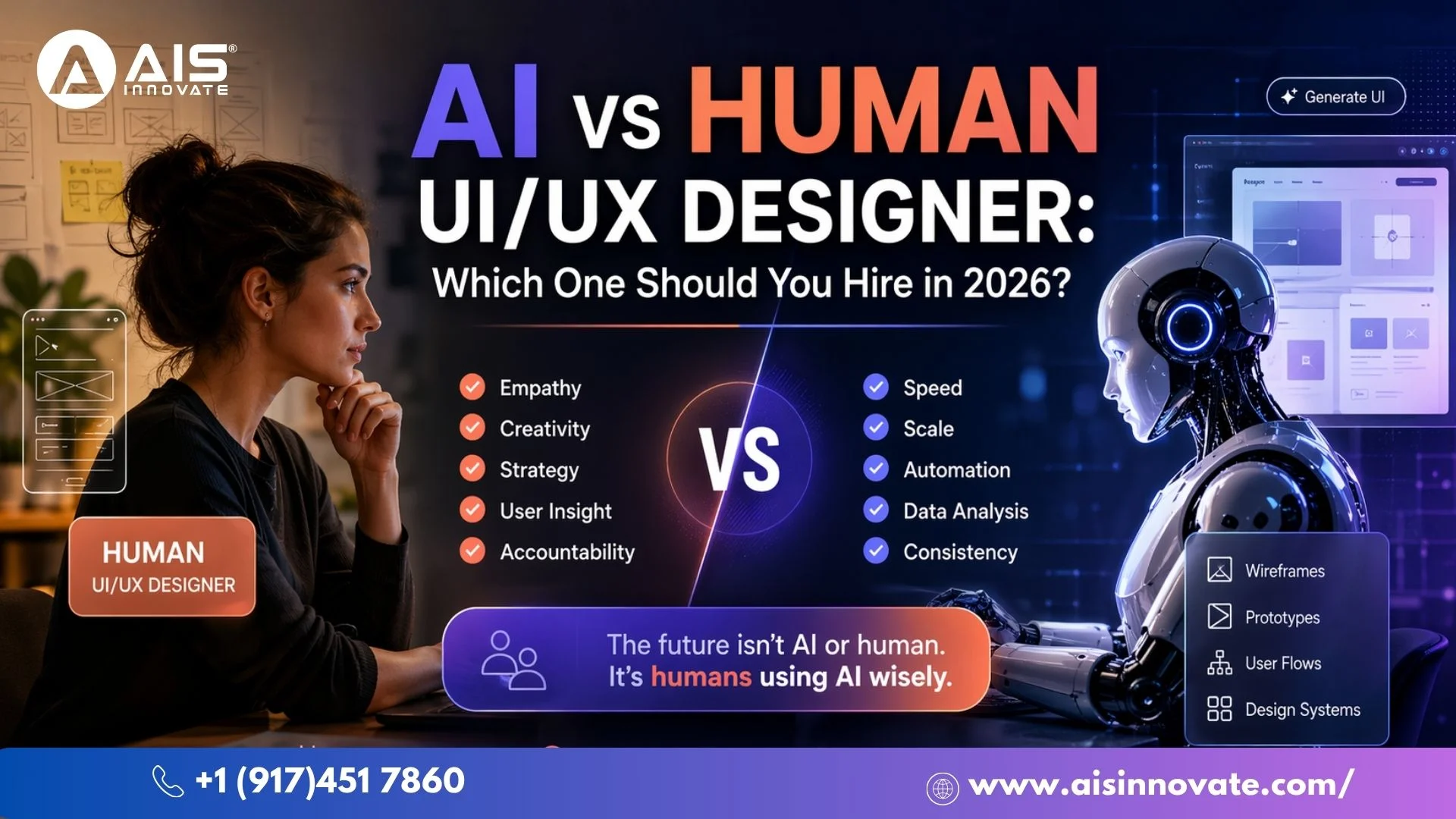
The future of UI/UX design isn't AI versus human. It's humans using AI wisely — and knowing when not to.
If you're hiring for a product that matters to real users, invest in that human wisdom first. Let the AI make it faster.
LET'S DISCUSS YOUR IDEAS
Build user experiences that convert. Work with experienced designers who combine creativity with AI-powered efficiency.
Hire UI/UX Experts Today
 11 March 2024